



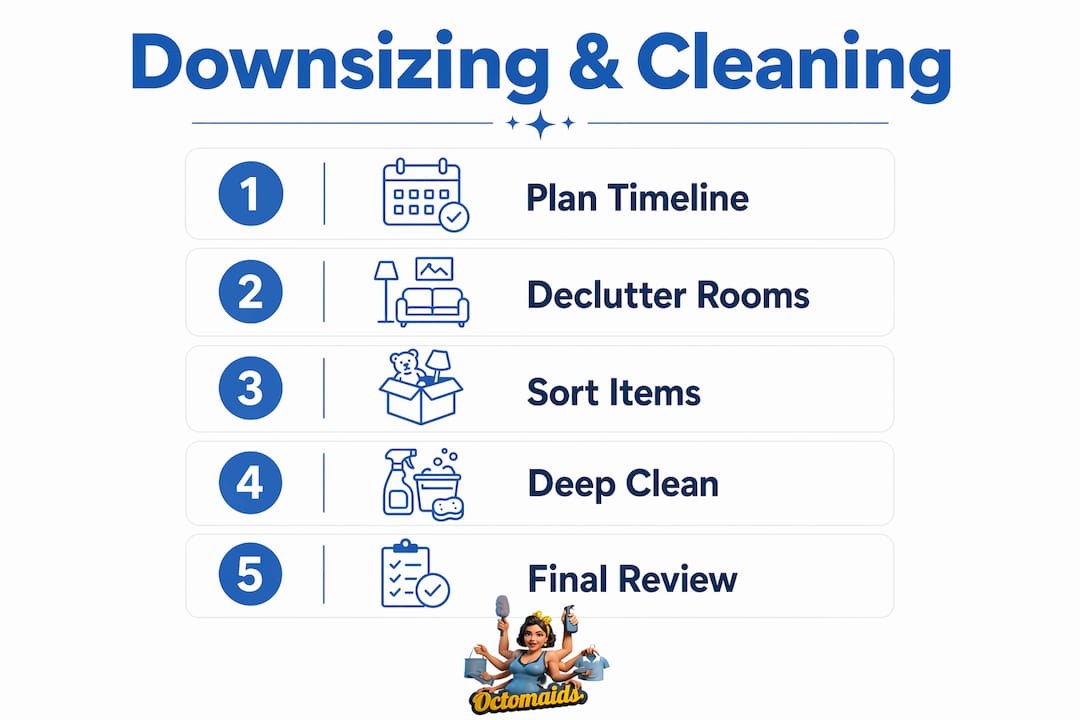
Downsizing and deep cleaning your home is defined as a two-phase process: first removing unnecessary possessions to reduce your moving load, then performing a top-to-bottom clean of every room before you leave or settle in. The professional term for this combined process is “move-out preparation,” and it works best when decluttering comes before any scrubbing. Methods like the 12-12-12 rule, the Keep/Sell/Donate/Discard system, and the American Cleaning Institute’s room-by-room cleaning order give you a repeatable framework that prevents rework and saves real time. Whether you are moving to a smaller space or simply ready to simplify your home, starting with a clear plan separates a smooth transition from a chaotic one.
How to downsize and deep clean your home: start with a timeline
The single biggest mistake people make is starting too late. Experts recommend beginning 6–8 weeks before moving day, using a room-by-room plan that starts with low-emotion storage areas. Starting early gives you time to make thoughtful decisions instead of reactive ones, which directly lowers moving costs and mental strain.
A calendar-based approach is the most reliable way to stay on track. Early planning optimizes decision-making and lowers moving costs by reducing the sheer volume of items you need to pack, transport, and unpack. Think of your calendar as a staging document, not just a reminder tool.
How to structure your timeline:
- Weeks 7–8 before moving: Tackle garages, attics, basements, and storage closets first. These spaces hold the most forgotten items and require the least emotional energy.
- Weeks 5–6: Move into bedrooms, home offices, and secondary living spaces.
- Weeks 3–4: Address the kitchen, living room, and shared spaces.
- Week 1–2: Final pass, donation drop-offs, and deep cleaning begins.
Time-boxed micro-sessions prevent burnout. The 12-12-12 rule asks you to find 12 items to keep, 12 to donate, and 12 to discard in a single session. The 5-5-5 method works similarly: spend five minutes in one spot, make five decisions, then stop. Both methods keep momentum without turning a Saturday into an exhausting marathon.
Pro Tip: Set a recurring 45-minute block on your calendar three times per week. Consistent short sessions outperform a single all-day push every time.
How do you declutter room by room without getting overwhelmed?
The room-by-room approach works because it gives you a visible finish line. Completing one space fully before moving to the next creates a sense of progress that keeps motivation high. Consistent sorting categories and time-boxed sessions reduce hesitation and decision fatigue across every room.

Use four fixed categories for every item you touch: Keep, Sell, Donate, and Discard. Avoid a “maybe” pile entirely. A maybe pile is just clutter with a polite label, and it always ends up back in a box.
Room-by-room decluttering order:
- Garage and storage areas: Sort tools, seasonal gear, and duplicates. If you have not used it in 18 months, it goes.
- Attic and basement: Focus on boxes that have not been opened since the last move. Unopened boxes are a reliable signal that the contents are not needed.
- Closets: Apply a three-question filter to every clothing item. Does it fit? Is it in good condition? Have you worn it in the past year? If the answer to any question is no, it leaves.
- Kitchen: Target duplicates and expired pantry items first. Most households own three or more versions of the same utensil. Keep the best one, donate the rest.
- Bedrooms and living areas: Focus on books, décor, and furniture that will not fit or suit the new space.
Sentimental items deserve their own session, not a rushed decision. Set them aside in a single box and revisit them after the practical rooms are done. Distance from the initial sorting session often makes those decisions easier.
Pro Tip: Take a photo of sentimental items before donating them. You preserve the memory without keeping the physical object, which is often what you actually wanted.
What is the correct order for deep cleaning after downsizing?
Cleaning should always follow decluttering, never precede it. Cleaning surfaces before clutter is removed causes dust redistribution and forces you to re-clean after items move. The American Cleaning Institute confirms this: clear first, then clean in zones following the same decluttering order.
The top-to-bottom method is the most efficient cleaning sequence. You start at ceiling height (fans, light fixtures, crown molding) and work downward through surfaces, furniture, and finally floors. Gravity does part of the work. Dust and debris fall to lower surfaces as you clean, which means you only clean each level once.
| Room | Top Priority Areas | Common Overlooked Spots |
|---|---|---|
| Kitchen | Inside oven, refrigerator coils | Cabinet tops, range hood filter |
| Bathroom | Grout lines, toilet base | Exhaust fan cover, behind toilet |
| Bedroom | Ceiling fan blades, baseboards | Under bed frame, inside closet shelves |
| Living Room | Light fixtures, window tracks | Behind sofa, under area rugs |
| Garage | Shelving units, floor drains | Door tracks, wall-mounted storage |
A full deep clean requires 8–20 hours depending on home size. That range means a two-bedroom apartment may take a full weekend, while a four-bedroom house often needs 2–3 dedicated days. Spreading the work prevents the quality drop that comes from cleaning while exhausted.
Key technique: clean before you disinfect. Dirt and organic matter block disinfectants from reaching surfaces, so applying a disinfectant to a visibly dirty surface is largely ineffective. Wipe the surface clean first, then apply an EPA-approved disinfectant and respect the full wet contact time listed on the label. Wiping too early undermines the product entirely.
Focus extra attention on high-touch surfaces like door handles, light switches, cabinet pulls, and faucet handles. These areas carry the highest germ load and are most often skipped during routine cleaning.
What tools and checklists make this process easier?
A printed or digital checklist is the most underrated tool in this process. Checklists tailored to room type increase thoroughness and prevent the common problem of finishing a room and realizing you forgot the baseboards or the inside of the medicine cabinet. The Octomaids deep clean checklist by room is a practical starting point for building your own.
For supplies, you need fewer products than most people think. A microfiber cloth set, an extendable duster, a grout brush, and a multi-surface cleaner handle the majority of tasks. For disinfection, choose EPA-registered products and read the label for dwell time, which is the amount of time the surface must stay wet for the product to work.
| Supply Category | Recommended Items | Purpose |
|---|---|---|
| Dusting | Extendable microfiber duster | Ceiling fans, light fixtures, crown molding |
| Scrubbing | Grout brush, non-scratch sponge | Tile, grout, stovetop |
| Disinfecting | EPA-approved spray or wipes | High-touch surfaces, bathrooms |
| Organization | Color-coded bins, label maker | Sorting Keep/Sell/Donate/Discard |
| Tracking | Printed room checklist | Ensuring no area is missed |
For digital tools, apps like Tody and OurHome let you assign cleaning tasks by room and track completion. Both are free to start and work well for households managing the process across multiple days or with multiple people helping.
Pro Tip: Assemble all your supplies in a single caddy before you start. Searching for a product mid-task breaks momentum and adds unnecessary time to every session.
Common mistakes that slow down your downsizing and deep clean
The most costly mistake is cleaning before decluttering. Moving items after you have already wiped down shelves means re-cleaning those same surfaces. A clear-first strategy avoids redundant work and the dust redistribution that comes from cleaning around clutter.
Mistakes to watch for and how to fix them:
- Starting too late: Compressing the process into the final week forces rushed decisions and poor cleaning quality. Begin 6–8 weeks out.
- Cleaning before clearing: Always declutter a room fully before you clean it. This is the rule with the highest return on effort.
- Creating “maybe” piles: These piles stall progress and almost always become a second round of the same decisions. Force a choice on every item.
- Ignoring disinfectant dwell time: Spraying and immediately wiping a surface does not disinfect it. The product needs time to work, typically 30 seconds to 4 minutes depending on the formula.
- Skipping high-touch areas: Door handles, light switches, and cabinet pulls are touched dozens of times daily. They need dedicated attention, not just a passing wipe.
- Trying to do everything at once: A single all-day session leads to fatigue and lower quality work in the final hours. Spread the process across multiple days.
Pro Tip: Walk through each finished room with your checklist before moving on. A two-minute review catches the spots you missed and saves you from backtracking later.
Key takeaways
The most effective way to downsize and deep clean your home is to declutter room by room first, then clean top-to-bottom using a checklist and EPA-approved products.
| Point | Details |
|---|---|
| Start 6–8 weeks early | Begin with storage areas to make low-stakes decisions before tackling emotional spaces. |
| Declutter before cleaning | Clearing clutter first prevents dust redistribution and eliminates the need to re-clean surfaces. |
| Clean top-to-bottom | Work from ceiling to floor in each room so falling debris does not dirty already-cleaned surfaces. |
| Use a room checklist | A written checklist prevents overlooked spots and tracks progress across multi-day sessions. |
| Respect disinfectant dwell time | Apply EPA-approved products and wait the full contact time before wiping for effective germ removal. |
What i have learned after watching hundreds of move-outs
I have seen the full range of how people approach this process, from the meticulous planner who starts two months out to the person who calls us the day before the truck arrives. The difference in outcomes is not subtle.
What strikes me most is how often people underestimate the emotional weight of letting go. A garage full of tools or a closet full of clothes is not just stuff. It represents decisions, memories, and sometimes identity. The people who move through that most gracefully are the ones who give themselves permission to feel it without letting it stall the process. A photo of a sentimental item is not a compromise. It is a genuinely good solution.
The other thing I would push back on is the idea that thoroughness and speed are opposites. When you follow a clear sequence, work room by room, and use a checklist, you actually move faster than someone who cleans randomly and backtracks constantly. Structure is not the enemy of efficiency. It is the source of it.
If you reach a point where the physical or emotional load feels like too much, that is not failure. That is a signal to ask for help. Professional move-out cleaning exists precisely for that moment, and using it is one of the smarter decisions you can make under time pressure.
— Steven
Let Octomaids handle the deep clean so you can focus on the move
Moving to a smaller space is already a full-time project. The last thing you need is to spend your final days scrubbing baseboards and cleaning oven racks.
Octomaids has served homeowners and renters across Vancouver, WA and Portland, OR since 2006. Our move-in and move-out cleaning services are built specifically for this moment: a thorough, top-to-bottom clean that covers every room on your checklist, from kitchen appliances to bathroom grout. Our family-owned team sends the same trusted cleaners every visit, so you know exactly who is walking through your door. If you want ongoing support after the move, our recurring cleaning service keeps your new space in shape without adding another task to your list. Book through our services page and cross the deep clean off your list for good.
FAQ
How early should you start downsizing before a move?
Begin 6–8 weeks before moving day, starting with low-emotion storage areas like garages and attics. This timeline gives you enough sessions to make thoughtful decisions without last-minute pressure.
Should you clean or declutter first?
Always declutter first. Cleaning before clearing causes dust redistribution and forces you to re-clean surfaces after items are removed, which wastes time.
How long does a full deep clean take?
A complete deep clean takes 8–20 hours depending on home size. Most people spread this across 2–3 days to maintain quality and avoid fatigue.
What is the 12-12-12 rule for downsizing?
The 12-12-12 rule asks you to find 12 items to keep, 12 to donate, and 12 to discard in a single session. It is a time-boxed method that maintains momentum without overwhelming decision fatigue.
What areas do people most often miss during a deep clean?
High-touch surfaces like door handles, light switches, and cabinet pulls are the most commonly skipped areas. Concentrating disinfection on these spots with full wet contact time is one of the highest-impact steps in any move-out clean.