


Professional cleaning pricing is structured around three core models: hourly rates, flat fees, and per-square-foot rates, each applied based on property type, job scope, and client preference. As of 2026, the average residential cleaning visit costs $120–$280, with hourly rates running $35–$75 per cleaner-hour. Understanding how professional cleaning pricing works before you request a quote puts you in a much stronger position to evaluate what you’re actually paying for. This guide breaks down every pricing model, the variables that move costs up or down, and what a legitimate quote should include.
How professional cleaning pricing works: the three core models
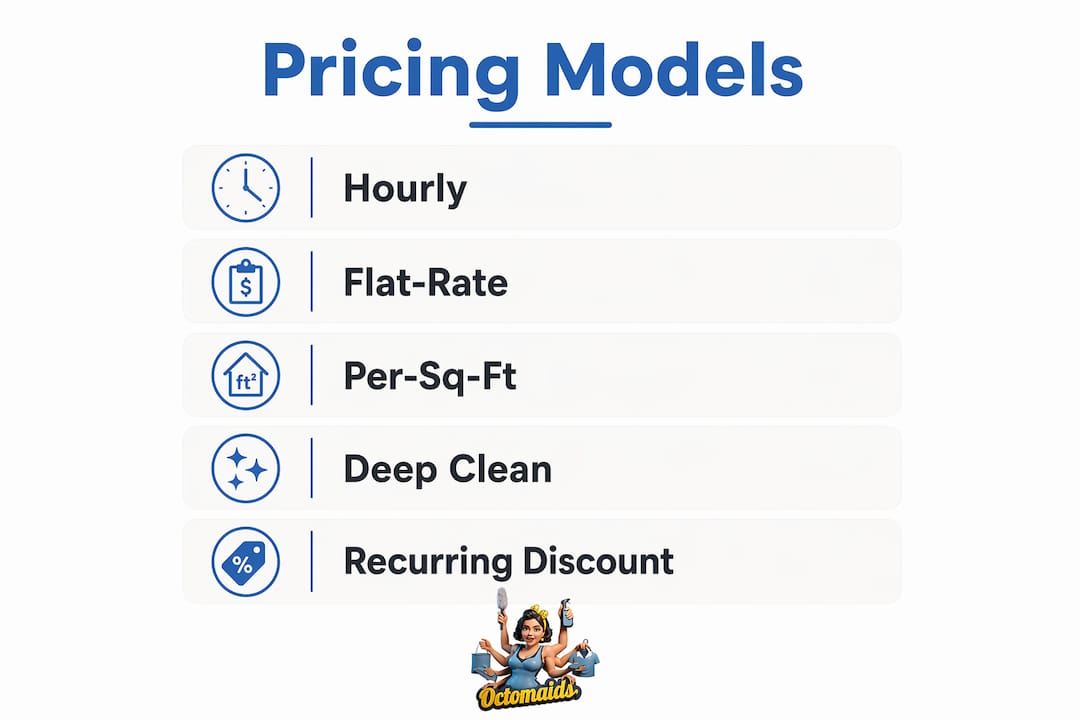
Professional cleaning companies use three primary pricing structures. No single model fits all jobs; experienced companies choose based on job type, property size, and client relationship.
Hourly pricing
Hourly pricing charges by the cleaner-hour. Most companies send two cleaners, so a three-hour job at $50 per cleaner-hour costs $300 total. This model works well for first-time or undefined jobs where the company cannot predict how long the work will take. The downside for you as a client is cost uncertainty. If the job runs long, your bill grows.

Flat-rate pricing
Flat-rate pricing quotes a fixed fee based on the home’s size, number of bedrooms and bathrooms, and the scope of work. Flat-rate pricing incentivizes efficiency and gives you cost certainty from the start. A company that quotes $180 and finishes in two hours earns an effective rate of $90 per hour. If they take three hours, their effective rate drops to $60 per hour. This model rewards well-trained, experienced teams and is the preferred structure for recurring residential clients.
Per-square-foot pricing
Per-square-foot pricing is standard for commercial properties and large residential homes. Square-footage rates typically run $0.05–$0.15 per square foot for standard cleaning, with higher rates for deep cleaning. This model allows for consistent, scalable quoting across properties of different sizes. A 2,000-square-foot office at $0.10 per square foot comes to $200 per visit.
Pro Tip: Experienced companies move to flat-rate pricing after collecting data on average cleaning times for each home size. If a company offers only hourly rates for recurring residential work, ask why. It may signal they haven’t yet built the operational data to quote confidently.
What factors influence the cost of cleaning services?
Several variables determine where your quote lands within the published price ranges. Knowing these factors helps you understand why two homes of similar size can receive very different quotes.
- Property size and layout. More square footage means more labor hours. Open floor plans clean faster than homes with many small rooms, hallways, and tight spaces.
- Service type. A standard cleaning covers surfaces, floors, and bathrooms. A deep cleaning goes further, addressing baseboards, inside appliances, and built-up grime. Deep cleaning costs 1.5 to 2 times more than a standard visit, ranging $200–$500. Move-out cleaning runs even higher at $250–$650 depending on unit size.
- Cleaning frequency. Recurring service schedules save homeowners 15–30% compared to one-time visits. A home cleaned every two weeks stays in better condition, which means less labor per visit.
- Add-on services. Oven cleaning adds $20–$50 to a base quote. Extra bedrooms add $25–$100 each. Refrigerator cleaning, window washing, and laundry services each carry separate line-item costs.
- Location and company size. Companies operating in Portland, OR or Vancouver, WA price differently than rural providers. Urban markets carry higher labor costs, insurance premiums, and overhead. Larger companies with vetted, insured staff typically charge more than solo operators.
- Current home condition. A home that hasn’t been professionally cleaned in months requires more time and supplies. Many companies charge a one-time “initial clean” premium to bring the property up to their maintenance standard.
How do cleaning companies calculate their rates?
Understanding what goes into a cleaning company’s rate helps you read quotes more critically. A quote is not just a labor cost. It reflects an entire business model.
- Fully-loaded labor cost. The hourly wage a cleaner earns is only part of the picture. True labor costs include wages, taxes, insurance, supplies, and overhead. Payroll taxes alone add roughly 15–20% on top of base wages. Workers’ compensation insurance, liability coverage, and benefits push that number higher. This is why a $25-per-hour cleaner costs the company far more than $25 per hour to deploy.
- Overhead costs. Cleaning supplies, transportation, equipment maintenance, scheduling software, and administrative staff all carry real costs. A professional company using commercial-grade products and background-checked employees has higher overhead than a solo operator with a mop and a bucket.
- Profit margin. A sustainable cleaning business builds a profit margin into every quote. This is not a red flag. It is what allows the company to invest in training, equipment, and consistent staffing. Margins in the cleaning industry typically run 10–28% depending on company size and market.
- Minimum viable rate. Most companies set a floor below which they will not quote. This minimum covers the cost of sending a team regardless of how small the job is.
Pro Tip: A quote that seems unusually low deserves scrutiny. Low hourly quotes may indicate an uninsured or non-vetted provider. Ask directly: Are your cleaners employees or contractors? Do you carry general liability and workers’ compensation insurance? The answers tell you a great deal about what you’re actually buying.
Pricing model comparison: real-world scenarios
Seeing the numbers side by side makes the differences between models concrete. The table below uses a standard 3-bedroom, 2-bathroom home as the baseline example.
| Scenario | Pricing Model | Estimated Cost | Notes |
|---|---|---|---|
| 3-bed/2-bath standard clean | Hourly ($50/hr, 2 cleaners, 2.5 hrs) | $250 | Cost varies if job runs long |
| 3-bed/2-bath standard clean | Flat rate | $180–$220 | Fixed cost, no surprises |
| 2,000 sq ft commercial office | Per square foot ($0.10/sq ft) | $200 | Consistent, scalable quoting |
| 3-bed/2-bath deep clean | Flat rate multiplier (1.5–2x) | $270–$440 | Higher labor and supply use |
| Move-out clean (2-bed apartment) | Flat rate or hourly | $250–$650 | Move-out commands highest prices due to complexity |
| Recurring bi-weekly standard clean | Flat rate with discount | $140–$180 | 15–30% savings vs. one-time |
The flat-rate model consistently delivers the most predictable cost for residential clients. Hourly pricing can work in your favor if the job finishes quickly, but it can also exceed your budget if the home requires more work than expected. For recurring service, the flat-rate discount structure makes the most financial sense over time. You can review recurring cleaning options to see how frequency affects your total annual cost.
Deep cleaning is where pricing surprises most homeowners. A standard clean for $180 can become a $360 deep clean when the scope expands to include appliances, baseboards, and cabinet interiors. Knowing this before you book prevents sticker shock. A deep clean house checklist helps you understand exactly what labor is involved at each service level.
Key takeaways
Professional cleaning pricing follows three defined models, and the one applied to your job directly determines your cost, your certainty, and the quality signals you should look for in a quote.
| Point | Details |
|---|---|
| Three pricing models exist | Hourly, flat-rate, and per-square-foot each serve different job types and client needs. |
| Deep cleaning costs significantly more | Expect to pay 1.5–2 times a standard rate, ranging $200–$500 per visit. |
| Recurring service saves money | Bi-weekly or weekly schedules reduce your cost by 15–30% compared to one-time bookings. |
| Low quotes carry real risk | Unusually cheap rates often signal missing insurance, unvetted staff, or hidden add-on fees. |
| Flat-rate pricing favors clients | Fixed fees give you cost certainty and reward efficient, experienced cleaning teams. |
What i’ve learned after years of watching pricing go wrong
I’ve seen homeowners make the same mistake repeatedly: they choose the lowest quote without asking what it actually includes. A $99 cleaning sounds great until the crew arrives, spends 45 minutes on a 2,000-square-foot home, and leaves the bathrooms half-done. That’s not a bargain. That’s a lesson.
The single most protective thing you can do before signing up for recurring service is request a written scope of work. A written scope and a trial clean clarify expectations for both sides and prevent the slow erosion of service quality that happens when nothing is documented. I’ve watched clients stay with underperforming companies for months simply because they never defined what “clean” meant in writing.
Flat-rate pricing is, in my view, the clearest signal of a mature, confident cleaning operation. A company that quotes flat rates has done the work of timing their crews, standardizing their process, and building a repeatable system. That discipline shows up in the quality of the clean. Hourly pricing, by contrast, can quietly reward slow work.
One more thing worth saying plainly: the market has changed. In the Portland and Vancouver, WA area, labor costs have risen, and the gap between a legitimate insured company and a low-cost solo operator has widened. Paying $40 more per visit for a vetted, insured team is not overpaying. It’s protecting your home and your liability.
— Steven
Transparent pricing from a team that’s been doing this since 2006
Octomaids has served homeowners and businesses in Vancouver, WA and the Portland Metro area for nearly two decades. Our pricing is flat-rate and quoted upfront based on your home’s size and the service type you need. No hourly surprises, no hidden add-on fees after the crew arrives.
Whether you need a one-time deep clean before a big event, a move-in or move-out clean to protect your deposit, or a recurring schedule that keeps your home consistently clean at a lower per-visit rate, Octomaids delivers the same trusted cleaners every visit. Request a free quote through our cleaning services page and see exactly what your home’s clean will cost before we arrive.
FAQ
What is the average cost of a professional house cleaning?
The average residential cleaning visit costs $120–$280, depending on home size, location, and condition. Hourly rates typically run $35–$75 per cleaner-hour.
Why does deep cleaning cost more than a standard clean?
Deep cleaning requires significantly more labor, time, and supplies than a standard visit. It typically costs 1.5 to 2 times more than standard cleaning, ranging from $200 to $500 per visit.
How much can i save with recurring cleaning service?
Recurring schedules save homeowners 15–30% compared to booking one-time visits. The more frequently you schedule, the lower your per-visit cost tends to be.
What is flat-rate pricing in cleaning services?
Flat-rate pricing quotes a fixed fee based on your home’s size and the scope of work, so your cost is set before the crew arrives. It is the most client-friendly model because it removes hourly cost uncertainty entirely.
How do i know if a cleaning quote is fair?
Ask whether the company carries liability insurance and workers’ compensation, and request a written scope of work. A fair quote reflects fully-loaded labor costs, overhead, and a reasonable profit margin, not just a low hourly number.