



The highest-priority high-traffic rental areas to deep clean are the entry/foyer, kitchen (appliances and floors), bathrooms (grout and fixtures), heavily used carpets and rugs, stairs and hallways, and HVAC filters along with all high-touch surfaces. These zones accumulate the most soil, harbor the most pathogens, and generate the most tenant-landlord disputes when neglected. Breezeway recommends deep cleaning rental properties every 1–3 months, with a minimum of four times per year, adjusted for occupancy level and guest type.
Here is where to start right now:
- Entry/foyer: Remove tracked-in soil, clean door glass and handles, replace or launder walk-off mats
- Kitchen: Clean oven and refrigerator interiors, degrease the range hood filter, scrub grout and splashback
- Bathrooms: Scrub tile grout, descale fixtures, clean the exhaust fan, check under-sink moisture
- Carpets and rugs: Extract high-use zones; address matting and odors before they penetrate the padding
- Stairs and hallways: Shampoo carpet runners, remove scuffs from walls and baseboards
- HVAC filters and high-touch surfaces: Replace or clean filters; disinfect doorknobs, light switches, and appliance handles following CDC and EPA guidance for contact time and product selection
For landlords and property managers in the Vancouver, WA and Portland, OR area, Octomaids handles full turnover and scheduled deep cleans for rental properties with consistent, background-checked crews.
Table of Contents
- What counts as a high-traffic area in your rental?
- Room-by-room deep-clean checklist for high-traffic areas
- Which tools and products work best by surface?
- Quick stain fixes for the most common rental messes
- High-touch disinfection: what to sanitize vs. what needs a deep clean
- Who is responsible for deep cleaning — landlord, tenant, or both?
- How long does a deep clean take, and what does it cost?
- How to hire a professional deep-clean service: a one-page checklist
- Why turnover deep cleans pay off: the ROI case
- Key Takeaways
- The part most landlords underestimate
- Octomaids handles your rental deep cleans in Vancouver, WA and Portland, OR
- FAQ
- Useful sources and further reading
What counts as a high-traffic area in your rental?
Not every room wears out at the same rate. High-traffic zones are the spaces people move through or use repeatedly throughout the day: entry and exit paths, shared corridors, kitchens, bathrooms, stairs, laundry areas, living rooms, and any carpet or rug that sits between two frequently used rooms. These are the surfaces that absorb the most soil, moisture, and friction.
The signs that a zone has crossed from routine-dirty to deep-clean-necessary are usually visible before they become expensive. Matted carpet fibers that no longer spring back, grout lines that have shifted from white to gray or brown, persistent odors that return within days of surface cleaning, recurring stains in the same spots, and an uptick in maintenance complaints or lower guest ratings all signal that surface cleaning is no longer enough.
Soil doesn’t just sit on top of a surface — it gets driven in. Foot traffic grinds particulate matter into carpet fibers and abrades hard-floor finishes, which is why high-traffic zones deteriorate faster than their square footage alone would suggest. Humidity and weather spikes accelerate this: in high-humidity markets, bathrooms require more frequent mold and grout checks because moisture creates conditions that routine cleaning cannot address.
Occupancy changes shift the priority order. A family group with young children, a pet-owning tenant, or back-to-back short-term rental bookings all compress the timeline between deep cleans. Pet presence in particular raises the stakes for carpet extraction, upholstery cleaning, and HVAC filter replacement, since dander and odor compounds work their way into porous surfaces faster than most landlords expect.
Room-by-room deep-clean checklist for high-traffic areas
Use this checklist at every turnover or scheduled deep-clean window. Tasks are grouped by urgency: address urgent items before re-renting; next week items can follow within seven days; scheduled items belong on a recurring calendar.
Entry and foyer (urgent)
- Lay 12–15 feet of walk-off matting at each exterior door to capture tracked-in soil before it reaches interior floors
- Wipe door glass, handles, and kick plates; disinfect with an EPA-registered product
- Vacuum and spot-clean transitional rugs; launder if machine-washable
- Wipe baseboards, window tracks, and door frames
Kitchen (urgent)
5. Clean oven interior, door seals, and drip pans; degrease range hood filter
6. Empty and wipe refrigerator interior, including door gaskets and drip pan
7. Scrub cabinet interiors and drawer liners; check for pest evidence
8. Descale tile grout and splashback; deep-scrub floor with a pH-neutral cleaner
9. Wipe appliance exteriors and handles thoroughly
Bathroom (urgent)
10. Scrub tile grout and descale fixtures (faucets, showerhead, toilet base)
11. Clean exhaust fan and vent cover; check for mold behind the toilet and under the sink
12. Wipe baseboards and door frames; replace caulk if discolored or cracked

Stairs and hallways (next week)
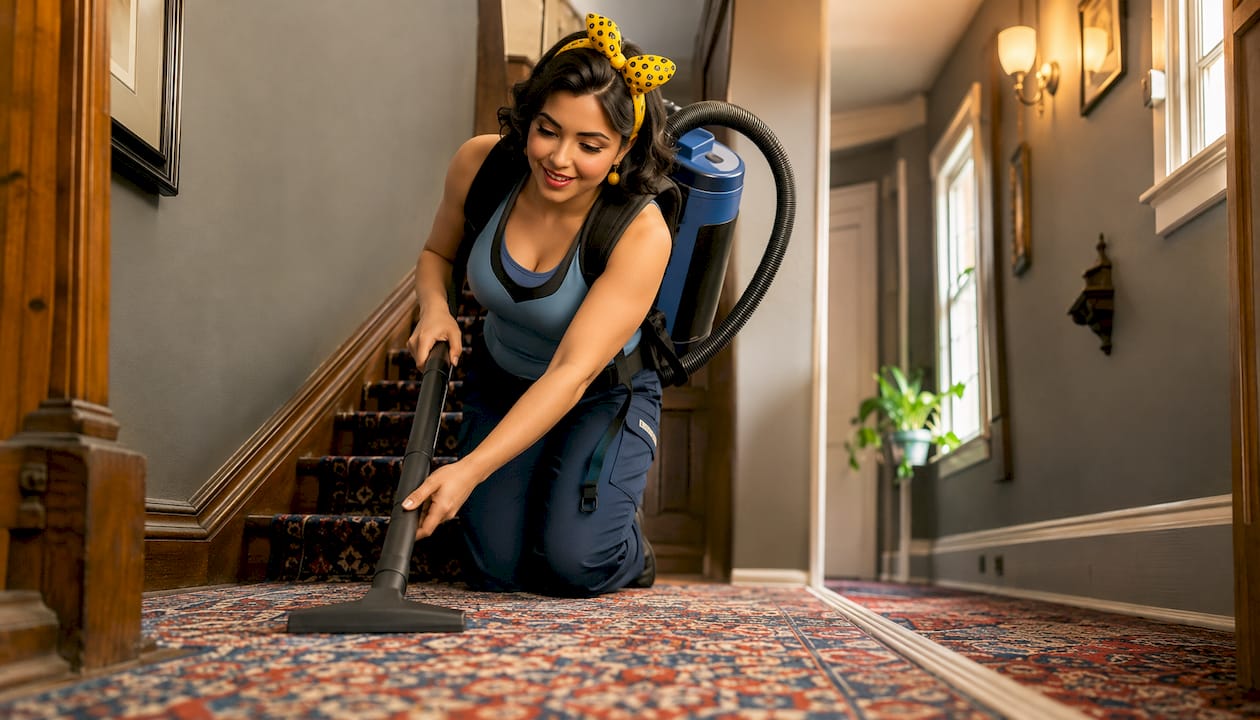
13. Shampoo or hot-water extract carpet runners; clean stair nosing
14. Remove scuffs from painted walls; wipe baseboards and light switches
Living room and upholstery (next week or optional by condition)
15. Steam or extract upholstery; vacuum under cushions and beneath furniture
16. Clean vent covers and ceiling fan blades; wipe remote controls and light switches
Carpets and rugs (urgent if odor or matting present)
17. Professional hot-water extraction for matted or odor-affected carpets; carpet extraction at move-out is often required by lease
18. High-occupancy vacation rentals should plan for more frequent carpet replacement than standard residential cycles, due to wear.
Laundry and shared spaces, HVAC (scheduled)
19. Clean lint trap and inspect dryer vent for blockage
20. Replace or clean HVAC filters; wipe high-touch surfaces in shared laundry areas
Commonly overlooked areas at turnover include oven door seals, range hood filters, ceiling fan blades, window tracks, wardrobe interiors, and the space behind appliances. These are also the spots most likely to trigger deposit disputes.
Which tools and products work best by surface?
Matching the right tool to the surface prevents damage and cuts cleaning time significantly.
Hard floors (sealed hardwood, LVP, tile)
pH-neutral cleaners are the correct daily-maintenance choice for sealed hard floors. Avoid over-applying any detergent: excess solution leaves a hazy film that attracts more dirt and is harder to remove than the original soil. Dust-mop before wet cleaning, change mop water frequently, and schedule a periodic strip-and-recoat for vinyl composition tile (VCT) when the shine dulls. Microfiber flat mops reduce residue better than traditional string mops.
Carpet and upholstery
Hot-water extraction (often called steam cleaning) is the most effective method for deep soil in carpet fibers and upholstered furniture. For immediate stains, a dedicated spot-cleaner applied before the stain sets prevents it from bonding to fibers. Portable extraction machines work for single rooms; professional truck-mount systems deliver more heat and suction for whole-unit turnovers.
Tile and grout
Enzymatic descalers and stiff-bristle grout brushes are the right combination for bathroom and kitchen grout. Avoid acidic solutions on natural stone (marble, travertine) since acid etches the surface permanently. For heavy calcium buildup on fixtures, a pH-neutral descaler applied with dwell time outperforms scrubbing alone.
Appliance interiors
Follow the product label on oven cleaners; most require ventilation and a dwell period. Refrigerator door gaskets collect mold in the folds and respond well to a diluted all-purpose cleaner and a soft brush. Range hood filters can usually be degreased in hot water with a few drops of dish soap, or run through a dishwasher cycle.
A note on ventilation: Heavy-duty degreasers, oven cleaners, and grout descalers release fumes that accumulate quickly in small spaces. Open windows, run exhaust fans, and wear gloves during any concentrated cleaning session. The EPA recommends following product label instructions precisely, including ventilation requirements and contact time, to protect both the cleaner and the surface.
Equipment for common areas and multi-unit properties
Backpack vacuums and cordless battery-powered scrubbers reduce trip hazards from hoses and cords in busy corridors. Auto-scrubbers are worth renting for large common areas like lobbies or laundry rooms where manual mopping is inefficient.
Pro Tip: For kitchen grout and splashback, try the kitchen cleaning approach of applying an alkaline degreaser, letting it dwell for 5–10 minutes, then agitating with a stiff brush before rinsing. The dwell time does most of the work.
Quick stain fixes for the most common rental messes
Speed matters with stains. The longer a substance sits, the deeper it bonds. Here is the correct sequence for each type:
-
Mud and tracked-in dirt: Let it dry completely before touching it. Vacuum the dried material to lift the bulk, then spot-clean with a pH-neutral detergent and a clean cloth. Rubbing wet mud spreads it and drives it deeper into fibers.
-
Salt stains on hard floors (common in winter): Sweep or dust-mop first to remove grit. Damp-mop with a diluted pH-neutral cleaner, then dry the floor thoroughly. Salt left in residue continues to abrade the finish.
-
Grease on kitchen surfaces: Apply an alkaline degreaser directly to the surface. Agitate with a microfiber cloth in a circular motion, then rinse completely to remove residue. Leaving degreaser on the surface attracts dust and creates a tacky film.
-
Pet urine: Blot immediately to remove as much liquid as possible. Apply an enzyme-based cleaner, which breaks down the uric acid compounds that cause persistent odor. If the urine has soaked through carpet into the padding, surface treatment alone will not eliminate the smell; hot-water extraction is required, and in severe cases, padding replacement.
-
Ink and permanent marker: Test an inconspicuous area first. Apply isopropyl alcohol sparingly with a clean cloth and blot (never rub). If the mark does not lift after two or three attempts, stop and call a professional. Aggressive rubbing spreads the pigment and can remove the surface finish.
The universal sequence: 1) contain the area, 2) blot rather than rub, 3) apply the correct cleaner for that substance, 4) rinse and dry completely.
High-touch disinfection: what to sanitize vs. what needs a deep clean
These two tasks are not the same, and confusing them leads to either over-cleaning (wasted time) or under-cleaning (health risk).
Sanitize at every turnover and multiple times daily in shared buildings:
Doorknobs, light switches, remote controls, appliance handles, faucet handles, toilet flush levers, and stair railings. High-touch surfaces may need cleaning multiple times daily in shared buildings to meaningfully reduce illness transmission risk. Use an EPA-registered disinfectant and follow the label’s contact time; wiping a surface and immediately drying it defeats the purpose.
Deep clean on a scheduled cycle:
Grout lines, vent covers, upholstery, appliance interiors, window tracks, and cabinet interiors require mechanical action, not just a disinfectant wipe. These surfaces accumulate biofilm, grease, and embedded soil that a spray-and-wipe cannot address. Monthly deep-clean tasks for high-use properties typically include oven, refrigerator, and grout scrubbing; semi-annual and annual work covers windows, HVAC filters, curtains, and ductwork.
The CDC’s guidance on environmental cleaning distinguishes between cleaning (removing visible soil), sanitizing (reducing microbial load on a surface), and disinfecting (killing pathogens to a defined standard). For rental properties, the practical takeaway is that disinfection without prior cleaning is less effective: soil physically blocks disinfectants from reaching the surface. Clean first, then disinfect.
Frequency by occupancy level:
Properties with higher occupancy should compress monthly deep-clean tasks to a more frequent schedule. Short-term rentals with back-to-back bookings need a full high-touch disinfection pass at every turnover, not just between longer tenancies.
Pro Tip: Keep a laminated high-touch surface checklist in the cleaning kit for each unit. It takes under two minutes to run through doorknobs, switches, and handles at turnover, and it creates a documented record that protects both landlord and tenant.
Who is responsible for deep cleaning — landlord, tenant, or both?
In the U.S., the baseline is clear: landlords must provide a habitable property that meets health and safety standards before a tenant moves in. What happens at move-out depends on the lease.
Most residential leases specify that tenants return the property in the same condition they received it, “normal wear and tear” excepted. The practical problem is that “same condition” is almost never defined precisely enough to prevent disputes. Landlords who require professional cleaning at move-out should state it explicitly in the lease, including the specific tasks required (carpet steam cleaning, oven interior, grout scrubbing) and the acceptable service level. Requiring a receipt from a licensed cleaning company is enforceable in most states when the lease language is clear.
Documentation is the single most effective dispute-prevention tool available to both parties. Pre-existing stains or wear documented at move-in cannot be charged at move-out. A detailed photo report taken at move-in, after each deep clean, and at move-out creates a timestamped record that resolves most deposit disputes before they reach small claims court. Use a standardized checklist, dated photos, and keep all receipts for professional services.
For short-term rentals, the responsibility structure is different: the host or property manager handles all cleaning between guests, and the cleaning fee charged to guests covers that cost. The benefits of professional move-out cleaning extend to both parties: renters get their deposit back, and landlords get a documented, rent-ready unit.
This article provides general information, not legal advice. Lease requirements and landlord-tenant law vary by state and locality; consult a qualified attorney or your state’s housing authority for guidance specific to your situation.
How long does a deep clean take, and what does it cost?
| Scope | Typical Time | Estimated Cost | Notes |
|---|---|---|---|
| Turnover clean (standard) | 1–3 hours | Included in turnover fee | Routine reset between tenants |
| Full deep clean (residential) | 3–8 hours | $300–$800 | Depends on size, condition, add-ons |
| Carpet extraction (add-on) | 1–2 hours per unit | Priced separately | Required for odor or heavy matting |
| Oven and appliance interior clean | 30 min | Priced separately | Often missed in standard turnover |
| Window washing (interior) | 1–2 hours | Priced separately | Semi-annual or annual task |
| HVAC filter replacement | 15–30 min | Low material cost | Monthly to quarterly depending on use |
The $300–$800 range for a full residential deep clean reflects most standard turnover scenarios; larger properties, heavy soil conditions, or multiple add-on services push costs toward the upper end. Scheduling within 24–48 hours of vacate gives the cleaning crew flexibility to address repairs and avoids premium same-day fees. Booking a week out when possible also allows time to order specialty products or equipment for specific conditions.
How to hire a professional deep-clean service: a one-page checklist
Not all cleaning companies scope rental turnovers the same way. These questions and requirements protect you before you sign anything.
Questions to ask before booking:
- Are you insured and bonded? Request a certificate of insurance, not just a verbal confirmation.
- What does your scope include? Ask specifically about appliance interiors, grout scrubbing, window tracks, and vent covers.
- Do you have experience with rental turnovers and move-out cleans?
- Will the same crew return for recurring visits? Crew consistency reduces re-briefing time and improves quality.
- Can you provide before-and-after photos and a signed completion checklist?
Scope items to require in writing:
- Hot-water carpet extraction (if carpeted)
- Oven and refrigerator interior cleaning
- Grout scrubbing in kitchen and bathrooms
- Window track and sill cleaning
- Baseboard and door-frame cleaning
- Exhaust fan and vent cover cleaning
Red flags to watch for:
- Vague scope language (“general cleaning” with no task list)
- No proof of insurance when asked
- Low-ball same-day bids with no walkthrough or inspection
- No photo documentation process or references from rental clients
Zone-based batching — grouping nearby properties and scheduling deep cleans on the same day — reduces crew travel time by 20–30% and lowers per-unit cost for landlords managing multiple units. Ask your cleaning company whether they offer this scheduling approach.
Why turnover deep cleans pay off: the ROI case
The financial argument for scheduled deep cleaning is straightforward. Turnover deep cleans that address appliance interiors, cabinet interiors, window tracks, and baseboards restore rent-ready appeal, limit odor and stain escalation, and reduce the likelihood of deposit disputes. A unit that photographs well and smells clean rents faster. A unit with grout discoloration, appliance buildup, and carpet odor sits longer and often requires a price concession.
The real cost of skipping a deep clean is rarely the cleaning fee itself. It is the compounding effect: a stain that costs $40 to treat at week two costs $400 to extract at month six, and may require carpet replacement at year two. Scheduled maintenance interrupts that escalation before it becomes a capital expense.
Octomaids has delivered consistent move-in/move-out and turnover cleaning services in the Vancouver, WA and Portland, OR area since 2006. Our teams follow a documented checklist with photo verification at each visit, which gives landlords a timestamped record for every deep clean. For properties with higher occupancy, we recommend compressing monthly deep-clean tasks to every 3–4 weeks and scheduling semi-annual specialist services for HVAC and ductwork. The short-term rental cleaning checklist we use for vacation rental clients reflects these tiered intervals.
Key Takeaways
Prioritizing the entry, kitchen, bathrooms, and carpets at every rental turnover prevents the soil escalation that turns routine maintenance into costly repairs.
| Point | Details |
|---|---|
| Start with these three zones | Entry/foyer, kitchen appliances and grout, and heavily used carpets need attention at every turnover. |
| Deep clean every 1–3 months | Breezeway recommends a minimum of four deep cleans per year; high-occupancy properties need more frequent cycles. |
| Document everything | Dated photos and signed checklists at move-in and move-out protect both landlords and tenants from deposit disputes. |
| Hire pros for heavy soil and odor | Professional extraction, duct cleaning, and certified services are worth the cost when DIY methods cannot reach the root cause. |
| Octomaids for local turnover service | Octomaids has served Vancouver, WA and Portland, OR since 2006 with consistent crews and photo-documented deep cleans for rental properties. |
The part most landlords underestimate
There is a pattern our team sees repeatedly: landlords who invest in thorough turnover deep cleans spend less money over a three-year period than those who skip them. The math is not complicated. A $400 deep clean at turnover prevents a $1,200 carpet replacement at year two and a $600 grout restoration at year three. What makes this hard to act on is that the savings are invisible. You never see the stain that did not set, the odor that did not penetrate the subfloor, or the deposit dispute that did not happen.
The other thing worth saying plainly: the entry mat situation in most rentals is quietly catastrophic. Walk-off matting is the single cheapest, highest-ROI item in a rental property’s cleaning program, and most properties either have none or have mats that are so saturated they are redepositing soil rather than capturing it. Replacing or laundering entry mats monthly costs almost nothing. Failing to do it means every cleaning session starts with a handicap.
My practical suggestion: walk your main entrance today. If the mat is matted flat, discolored, or curling at the edges, replace it before the next tenant arrives. Then schedule it for monthly cleaning. That one habit change will reduce your kitchen and hallway cleaning time at every subsequent turnover.
Octomaids handles your rental deep cleans in Vancouver, WA and Portland, OR
Turnover cleaning done right takes time, the right equipment, and a documented process. Octomaids has been doing exactly that for rental property owners throughout Clark County, WA and the Portland Metro area since 2006.
Our move-in/move-out cleaning service covers the full scope: appliance interiors, grout scrubbing, carpet extraction coordination, window tracks, baseboards, and high-touch disinfection. Every visit uses the same background-checked crew, so nothing gets missed and you get a consistent result you can document. Whether you manage one rental or a portfolio of short-term properties, we offer one-time deep cleans, recurring turnover service, and scheduled maintenance cycles. For a clear picture of which cleaning tasks are worth hiring out versus handling yourself, that page breaks it down by time, skill, and cost. To get a quote or book your next turnover clean, visit octomaids.com/services or call our team directly.
FAQ
What are the most overlooked areas to clean in a rental?
Oven door seals, range hood filters, ceiling fan blades, window tracks, wardrobe interiors, and the space behind appliances are the areas most commonly missed at turnover. These spots are also the most likely to generate deposit disputes.
Are landlords required to deep clean between tenants?
U.S. landlords must provide a habitable property that meets health and safety standards, which typically means a professionally cleaned unit at move-in. Lease language determines what tenants owe at move-out; requiring professional cleaning with receipts is enforceable when stated clearly in the lease.
What are the highest-priority areas to clean in a rental?
The entry/foyer, kitchen (appliances and grout), bathrooms (tile and fixtures), and heavily used carpets are the highest-priority zones because they accumulate the most soil, odor, and wear between tenancies.
How much does a professional deep clean cost for a rental?
Professional deep cleans for residential rental properties typically run $300–$800, depending on property size, condition at vacate, and add-on services like carpet extraction or oven cleaning. Scheduling within 24–48 hours of vacate avoids premium same-day fees.
How often should a rental property be deep cleaned?
Most rental properties should be deep cleaned every 1–3 months, with a minimum of four times per year. High-occupancy properties and short-term rentals with back-to-back bookings often need that cycle compressed to every 3–4 weeks.
Useful sources and further reading
| Source | What it covers |
|---|---|
| Breezeway: Deep clean frequency for vacation rentals | Frequency benchmarks: every 1–3 months, minimum four times per year, adjusted for occupancy |
| RapidEye: Vacation rental deep cleaning checklist | Tiered schedule (monthly, quarterly, semi-annual, annual); zone-based batching for multi-unit efficiency |
| Pro-San: Floor cleaning tips for high-traffic areas | pH-neutral cleaners, detergent dilution, VCT strip-and-recoat, cordless equipment safety |
| Summit Janitorial: High-traffic area cleaning | Prioritizing by traffic intensity; high-touch surface frequency guidance |
| Amherst Cleaning Services: Rental turnover guide | Cost ranges ($300–$800), scheduling within 24–48 hours of vacate |
| Titus GC: Rental turnover cleaning checklist | Commonly overlooked areas at turnover (oven seals, fan blades, window tracks) |
| Cleaning Business: Floor care in high-traffic areas | Humidity and weather effects on cleaning frequency; mold risk in bathrooms |
| CDC: Environmental cleaning guidance | Disinfection contact time, product selection, and cleaning vs. sanitizing vs. disinfecting |
| Realtor Cleaning Guide: Rental turnover for property managers | Scope of turnover deep cleans; dispute prevention through documented checklists |