


“Domestic help” is an umbrella term covering every paid worker who supports a household’s daily life, from housekeepers and nannies to caregivers, private cooks, and estate managers. It is broader than “house help” or “housekeeping,” which typically refers only to physical cleaning and maintenance. Caregiving tasks like bathing, dressing, and medication reminders fall squarely under domestic help but have nothing to do with a mop and bucket.
Before you post a job or call an agency, three steps matter most:
- Define your needs precisely. Write down every task, how often it happens, and what “done well” looks like.
- Decide live-in or live-out. The answer changes compensation, legal obligations, and your household’s daily rhythm.
- Require a written employment agreement. The National Domestic Workers Alliance identifies written job descriptions and clear compensation terms as the single most effective retention tool in household employment.
If your primary need is recurring cleaning rather than a full household employee, a vetted cleaning service like Octomaids handles payroll, background checks, and scheduling for you, removing most of the employer liability described in this guide.
Table of Contents
- What types of domestic help roles exist, and what does each one do?
- Live-in vs. live-out: which arrangement fits your household?
- How to define your needs and write a clear job description
- Where to find household help: sourcing channels and their tradeoffs
- The hiring checklist: interviews, references, background checks, and trial periods
- Pay, benefits, and U.S. legal obligations every household employer must understand
- Managing household staff: schedules, boundaries, reviews, and ending employment well
- Why agencies and vetted services reduce your hiring risk
- Key Takeaways
- The part of domestic hiring most guides skip
- Octomaids handles the cleaning so you do not have to hire for it
- Useful sources and further reading
- FAQ
What types of domestic help roles exist, and what does each one do?
Households often hire the wrong role because job titles in this field are used loosely. Here is a clear breakdown of the most common positions and what they actually involve.

Housekeeper/maid. Recurring cleaning, laundry, linen changes, and light organizing. Some housekeepers also handle grocery runs or meal prep, but those are add-ons to negotiate explicitly. If you want to understand exactly where light housekeeping ends and deeper cleaning begins, that distinction matters for the job description.
Nanny. Childcare is the primary duty: feeding, school pickup, homework help, and developmental activities. Housekeeping is secondary and should be limited to child-related tasks (tidying the playroom, washing bottles) unless the role is explicitly a “nanny-housekeeper” hybrid.
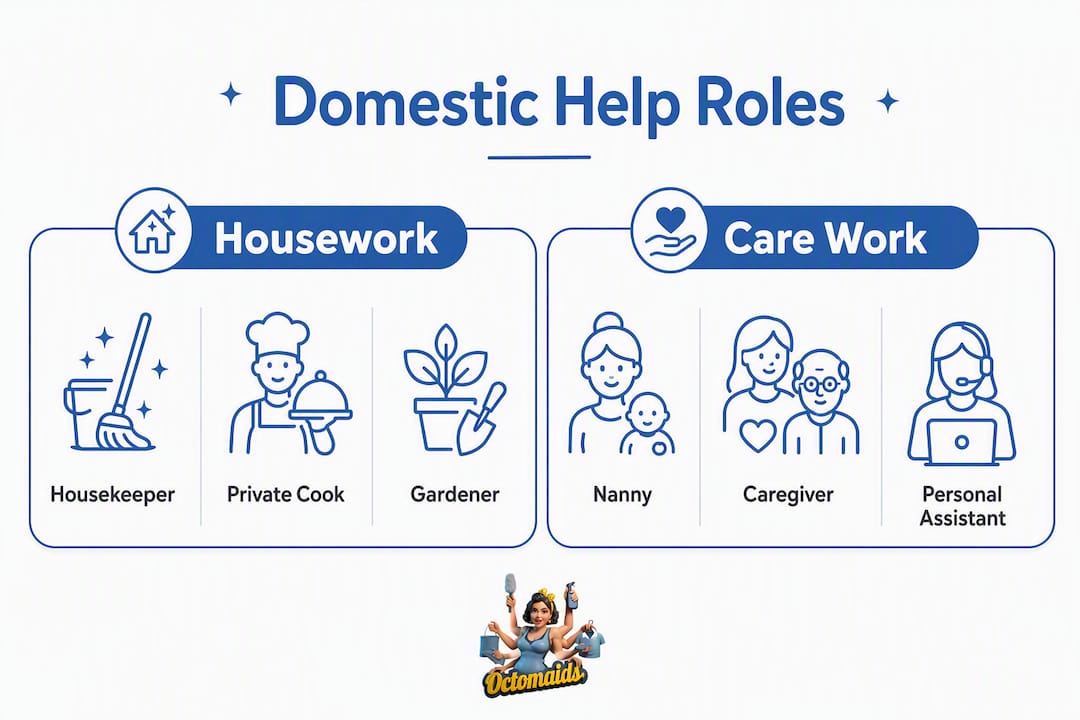
Caregiver/home health aide. Personal care for older adults or people with disabilities: bathing, dressing, grooming, mobility assistance, and medication reminders. The National Institute on Aging notes that home-based services for older adults range from companionship and household help to in-home nursing and rehabilitation, so the level of medical training required varies significantly by role. For households with older adults, senior-specific cleaning practices are worth reviewing separately from caregiving duties.
Personal assistant. Scheduling, correspondence, errands, travel coordination, and vendor management. This role is common in high-demand households where the employer’s time is the scarce resource.
Private cook. Menu planning, grocery sourcing, meal preparation, and kitchen cleanliness. A private cook is not a housekeeper; conflating the two in a job posting almost always creates friction.
Chauffeur/driver. School runs, medical appointments, airport transfers. Some households combine this with personal assistant duties, but driving certifications and a clean motor vehicle record are non-negotiable requirements.
House manager/estate manager. Oversight of all household staff, vendor relationships, property maintenance schedules, and household budgets. This is a senior role requiring management experience, not just domestic skills.
Gardener/handyman. Lawn care, seasonal planting, minor repairs, and exterior upkeep. Often hired on a part-time or contract basis rather than as a household employee.
Pro Tip: Separate “care work” and “housework” in every job description you write. Combining them in a single posting attracts candidates who are strong in one area and weak in the other, which is a leading driver of early turnover in household employment.
Live-in vs. live-out: which arrangement fits your household?
Live-in domestic help means the worker resides in the employer’s home or a separate on-site dwelling, making them available outside standard working hours. Live-out workers commute daily and leave at the end of their scheduled shift.
Live-in benefits:
- Greater availability for early mornings, late evenings, and unpredictable schedules
- Often lower total cash compensation because housing and meals offset wages
- Continuity of care, especially valuable for eldercare and infant nannying
Live-out benefits:
- Clearer work/life boundaries for both parties
- No housing accommodation required from the employer
- Easier to comply with overtime rules because hours are more predictable
Legal flags to watch. Live-in workers are still covered by the Fair Labor Standards Act for minimum wage, but overtime rules differ. Some states with Domestic Worker Bills of Rights add rest-period and overtime requirements that go beyond the federal baseline. California’s AB 241, for example, extends overtime protections to personal attendants. Always check your state’s rules before setting compensation.
Decision checklist:
- Do you need coverage before 7 AM or after 9 PM regularly? Live-in is worth considering.
- Do you have a private bedroom and bathroom to offer? If not, live-out is the practical default.
- Is your schedule highly unpredictable (frequent travel, irregular hours)? Live-in reduces scheduling friction.
- Are you prepared to manage the privacy and boundary dynamics of sharing your home with an employee? That is a real lifestyle consideration, not just a logistical one.
How to define your needs and write a clear job description
Vague job descriptions are the root cause of most household employment disputes. A well-written description sets expectations before the first interview, not after the first conflict.
Every job description for household staff should include these sections:
- Job title (specific: “Full-Time Housekeeper,” not “Helper”)
- Hours and schedule (days, start/end times, on-call expectations)
- Duties and frequency (itemized, not summarized — “vacuum all carpeted rooms twice weekly” beats “light housekeeping”)
- Required skills or certifications (CPR for nannies, valid driver’s license for drivers)
- Pay range and pay period
- Benefits (paid time off, sick leave, health contribution if offered)
- Reporting line (who the worker reports to, how feedback is given)
- Trial period (typically two to four weeks, with defined performance expectations)
- Termination notice (two weeks is standard; specify both directions)
On confidentiality: household workers have access to your home, your routines, your children, and often your financial information. A brief confidentiality clause covering personal data, household finances, and social media posting is not excessive. It is standard practice.
Smartphone and device policies are worth a sentence too. Specify whether personal phone use is permitted during working hours and under what circumstances. Ambiguity here creates resentment on both sides.
Where to find household help: sourcing channels and their tradeoffs
| Sourcing channel | Vetting | Payroll responsibility | Insurance | Cost | Best for |
|---|---|---|---|---|---|
| Professional agency | Agency handles background checks and references | Agency (worker is agency employee) | Agency carries liability | Higher upfront | Eldercare, nannying, estate management |
| Vetted cleaning company (e.g., Octomaids) | Company handles background checks | Company handles payroll | Company insured | Predictable per-visit | Recurring or one-time cleaning |
| Online gig platforms | Varies; often self-reported | Homeowner (if classified as employee) | Homeowner’s responsibility | Lower upfront | Flexible, short-term tasks |
| Word-of-mouth referrals | Informal; relies on your network | Homeowner | Homeowner’s responsibility | Varies | Trusted relationships, lower-stakes roles |
Home-care agencies and professional cleaning companies commonly handle payroll, taxes, insurance, and background checks, shifting many employer responsibilities away from the homeowner. That shift has real value: a homeowner who hires an individual directly becomes a household employer with federal and state tax obligations, workers’ compensation requirements, and potential FLSA liability.
Questions to ask any agency before signing:
- Do you carry general liability and workers’ compensation insurance?
- What does your background-check process include (criminal, employment history, references)?
- Who handles payroll and tax withholding?
- What is your replacement policy if a worker is unavailable?
For cleaning-specific needs, comparing a recurring clean versus a one-time deep clean before you contact a service helps you ask for exactly what you need. If you are preparing a home for sale or a rental turnover, a partner like Fix. Move. Haul. offers realtor-focused move and cleaning prep services worth considering alongside a standard cleaning company.
The hiring checklist: interviews, references, background checks, and trial periods
A structured hiring process protects both the household and the worker. Follow these steps in order.
- Write and post the job description. Use the template from the previous section. Post on reputable platforms or through an agency.
- Screen applications. Look for documented work history in the specific role, not just general “household experience.”
- Conduct a structured interview. Ask role-specific questions (see below). Take notes.
- Check references. Call at least two previous employers directly. Do not rely on written letters alone.
- Run a background check. Criminal history, employment verification, and driving record (if driving is part of the role). Use a reputable screening service.
- Offer a paid trial shift or trial period. Two to four weeks is standard. Define measurable expectations in writing before it begins.
- Sign a written employment agreement. Cover duties, pay, schedule, confidentiality, termination terms, and dispute resolution.
Sample interview questions by role:
- Housekeeper: “Walk me through how you would clean a kitchen after a dinner party. What products do you use and why?”
- Nanny: “Describe how you handled a situation where a child in your care was upset or unwell and you could not reach the parents immediately.”
- Caregiver: “What experience do you have assisting with mobility or personal care? Are you CPR-certified?”
Reference red flags: a former employer who gives only dates of employment and job title (and nothing more), inconsistencies between what the candidate described and what the reference recalls, or a reference who seems reluctant to recommend rehiring.
Trial period structure. Set two or three specific, observable performance expectations at the start (e.g., “all common areas cleaned by 11 AM on scheduled days,” “child pickup completed within five minutes of school dismissal”). Review them at the midpoint and end of the trial. This makes the conversation factual rather than subjective.
Pay, benefits, and U.S. legal obligations every household employer must understand
Hiring a domestic worker in the U.S. means taking on employer responsibilities that most families underestimate. The starting point is federal law.

FLSA Fact Sheet #79 from the U.S. Department of Labor covers private-home domestic service and defines which workers qualify as household employees. Most full-time domestic workers, including housekeepers, nannies, and caregivers, fall under FLSA minimum wage and overtime protections. Some states go further: state Domestic Worker Bills of Rights add overtime thresholds, rest-period requirements, and written-agreement mandates beyond the federal baseline.
Core employer obligations when hiring a household employee directly:
- Verify work authorization (Form I-9)
- Withhold and pay Social Security and Medicare taxes (FICA)
- Issue a Form W-2 at year end
- Pay federal unemployment tax (FUTA) if wages exceed the IRS threshold
- Carry workers’ compensation insurance (requirements vary by state)
- Pay at least federal minimum wage; overtime at 1.5x for hours over 40 per week for most covered workers
Payroll setup options. Household payroll services like SurePayroll or HomePay (by Care.com) handle withholding calculations, quarterly filings, and W-2 generation for a monthly fee. They are worth the cost for most families because the penalty for misclassifying a household employee or failing to withhold correctly can exceed the annual service fee many times over.
Typical pay considerations. Pay rates for household workers vary significantly by role, region, and experience. Nannies in major metro areas often command higher rates than housekeepers in the same market. Offering paid time off and sick leave, even when not legally required in your state, meaningfully improves retention.
Pro Tip: Hiring through an agency rather than directly often shifts payroll and tax withholding obligations off the homeowner entirely. If administrative complexity is a concern, that tradeoff alone can justify the agency premium.
Managing household staff: schedules, boundaries, reviews, and ending employment well
Good management of household staff is quieter than most people expect. It is less about authority and more about consistency.
Scheduling and boundaries:
- Provide a written weekly schedule at least one week in advance
- Define on-call expectations explicitly (is a 10 PM text acceptable? Under what circumstances?)
- Establish guest and visitor policies for when the worker is present
- Agree on break times, meal arrangements, and personal phone use during shifts
Performance reviews. A brief monthly check-in, 15 minutes or less, prevents small frustrations from becoming resignation letters. Ask two questions: “Is there anything making your work harder than it needs to be?” and “Is there anything you need from me to do your job better?” Then listen. The National Domestic Workers Alliance notes that isolation is a structural feature of domestic work, and scheduled check-ins are among the most effective tools for catching problems early.
Privacy and household safety. Key and alarm code access should be documented and limited to what the role requires. Change alarm codes when employment ends. Keep a simple log of who has access to what. For a practical reference on maintaining your home between professional visits, that kind of routine documentation applies to household management broadly.
Ending employment. Give written notice per the agreement. Pay all earned wages, including any accrued paid time off your state requires to be paid out. Provide a factual reference if asked. Retrieve keys, access cards, and any household property. Change alarm codes and, if the worker had smart-home access, revoke those credentials the same day.
Pro Tip: A brief, written separation letter stating the final date of employment and confirming receipt of final pay protects both parties and closes the employment relationship cleanly.
Why agencies and vetted services reduce your hiring risk
The practical case for using an agency or vetted cleaning company comes down to who carries the administrative and legal burden.
Professional cleaning companies and home-care agencies reduce many homeowner liabilities by providing vetted staff and handling payroll internally. When you hire through a properly structured agency, the worker is the agency’s employee, not yours. That means the agency handles FICA withholding, workers’ compensation, and unemployment insurance. If the worker is injured on your property, the agency’s insurance responds first.
Checklist for evaluating any agency or vetted service:
- Carries general liability insurance (ask for the certificate)
- Conducts criminal background checks and employment-history verification on all workers
- Handles payroll and tax withholding internally
- Has a clear replacement policy for absences
- Provides a written service agreement with termination terms
- Can supply client references in your area
For cleaning specifically, what professional cleaners do differently from an individual hire goes beyond technique. It includes accountability structures, supply standardization, and the ability to send a replacement without the homeowner re-screening anyone.
Key Takeaways
Hiring domestic help in the U.S. requires written agreements, FLSA compliance, and a clear decision between direct employment and agency-managed services.
| Point | Details |
|---|---|
| Define needs before posting | Write an itemized job description covering duties, hours, pay, and a trial period before contacting any candidate or agency. |
| Written agreements protect both parties | A signed employment agreement covering duties, pay, confidentiality, and termination terms is the single most effective retention and dispute-prevention tool. |
| FLSA applies to most household workers | Federal law covers minimum wage and overtime for most domestic workers; state Domestic Worker Bills of Rights may add further requirements. |
| Agency hiring shifts employer liability | When you hire through a properly structured agency, the agency handles payroll, taxes, workers’ comp, and background checks, not you. |
| Octomaids for cleaning-specific needs | For recurring or one-time cleaning in the Vancouver, WA and Portland, OR metro areas, Octomaids provides background-checked teams with payroll handled by the company. |
The part of domestic hiring most guides skip
Most hiring guides treat domestic employment as a purely logistical problem: post a job, run a background check, sign a contract. What they underestimate is the relational dimension, and it is where most household employment relationships actually break down.
Domestic workers operate inside your private life. They see your household at its most unguarded: the dishes left from an argument, the medication on the counter, the way you speak to your children when you think no one is paying attention. That intimacy creates a workplace dynamic that has no real parallel in an office environment.
The families I have seen manage household staff well share one habit: they treat the employment relationship as a real professional relationship, not a personal favor or a service transaction. That means scheduled feedback, written expectations, and genuine respect for the worker’s time and boundaries. It also means being honest about what the role actually requires before someone accepts it.
The instinct to be “nice” by leaving things vague almost always backfires. Vague expectations feel like flexibility at first and like moving goalposts six weeks later. A clear, written job description is not cold or corporate. It is the most respectful thing you can offer someone who is about to work inside your home.
Octomaids handles the cleaning so you do not have to hire for it
For many families reading this guide, the core need is not a full household employee. It is reliable, professional cleaning, handled consistently, without the payroll paperwork.
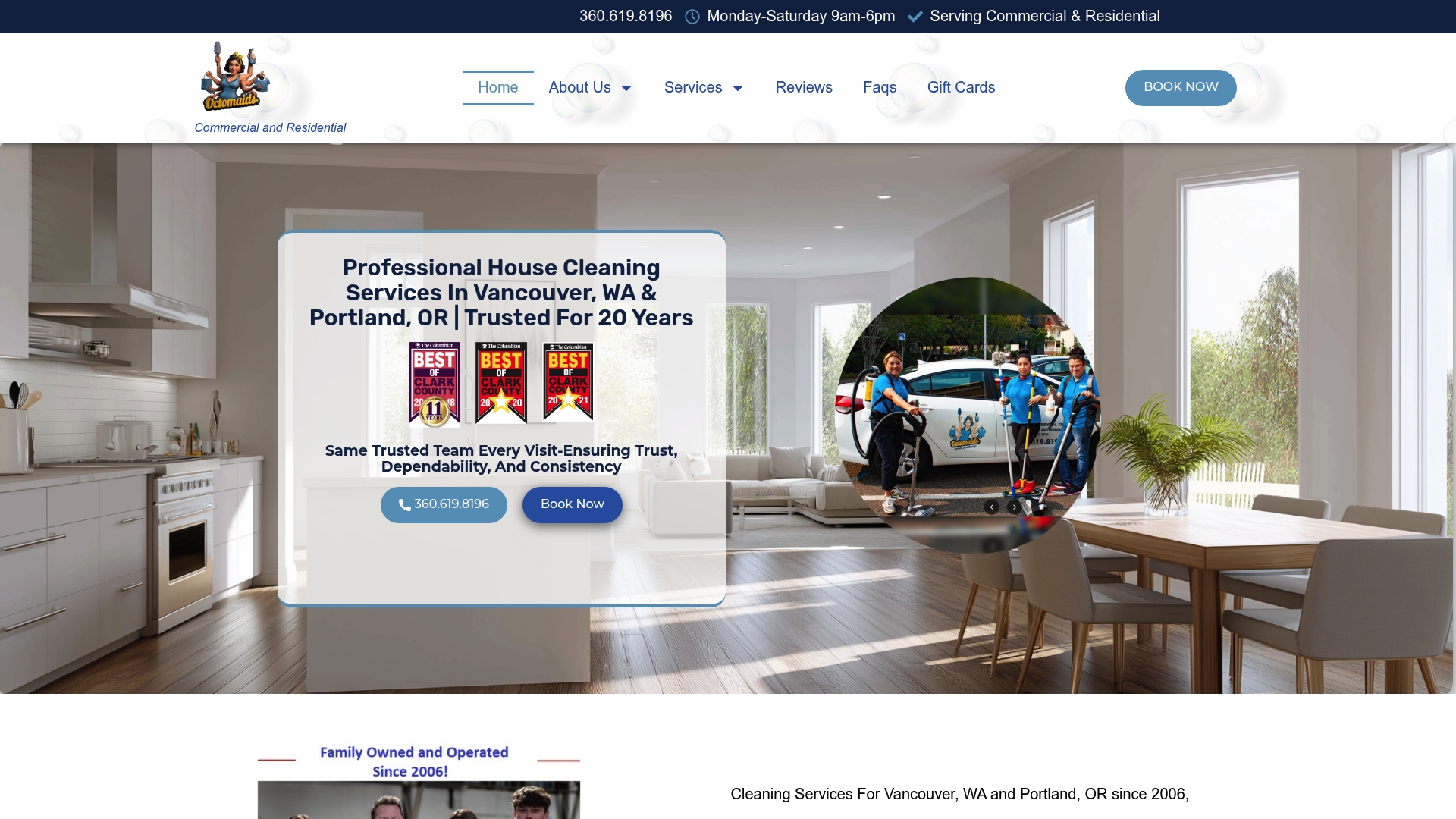
Octomaids has served homeowners and businesses in the Vancouver, WA and Portland, OR metro areas since 2006. Every team is background-checked, payroll is handled by the company, and the same trusted cleaners return each visit. There is no W-2 to file, no workers’ comp policy to manage, and no re-screening when someone calls in sick.
Services include recurring house cleaning, one-time deep cleans, move-in/move-out cleaning, short-term rental turnover, and office cleaning. If you are weighing which tasks are worth delegating to a professional, the cleaning tasks worth hiring out guide is a practical starting point.
To see the full range of services or request a quote, visit the Octomaids services page.
Useful sources and further reading
- FLSA Fact Sheet #79: Private Homes and Domestic Service Employment — The authoritative federal reference for which domestic workers are covered by minimum wage and overtime rules. Start here for payroll compliance questions.
- National Domestic Workers Alliance: About Domestic Work — Covers worker rights, written agreement best practices, and state-level Domestic Worker Bills of Rights. Useful for both employers and workers navigating fair employment standards.
- National Institute on Aging: Services for Older Adults Living at Home — Explains the range of home-based services available for eldercare, from companionship to in-home nursing. Use this when hiring for a caregiving role.
- Octomaids: What Is a Light Housekeeping Service? — Clarifies the scope of light housekeeping versus deeper cleaning, useful when writing a housekeeper job description.
- Octomaids: Deep Clean vs Regular Clean — Helps you decide whether recurring cleaning or a one-time deep clean fits your situation before contacting a service.
FAQ
What does “domestic help” mean?
Domestic help is an umbrella term for paid workers who support a household’s daily life, including housekeepers, nannies, caregivers, cooks, personal assistants, and estate managers. It covers both physical household maintenance and personal care tasks like bathing, dressing, and medication reminders.
What is the difference between domestic help and house help?
House help or housekeeping typically refers to physical cleaning and household maintenance only. Domestic help is broader, encompassing caregiving, childcare, cooking, driving, and household management in addition to cleaning duties.
What does a domestic helper do day to day?
Daily tasks depend on the role: a housekeeper cleans and does laundry, a nanny manages childcare and school logistics, and a caregiver assists with personal care and mobility. Most domestic workers handle a defined set of recurring tasks outlined in a written job description.
What is live-in domestic help?
Live-in domestic help refers to a worker who resides in the employer’s home or a separate on-site dwelling, making them available outside standard working hours. Live-in arrangements are common for intensive roles like eldercare and infant nannying, and they trigger different compensation and hour considerations under federal and state law.
Do I need to pay taxes if I hire domestic help?
Yes, in most cases. If you hire a household employee directly and pay them above the IRS threshold, you are responsible for FICA withholding, federal unemployment tax, and a Form W-2 at year end. Hiring through a properly structured agency shifts those obligations to the agency. Consult DOL Fact Sheet #79 and a tax professional for your specific situation.