

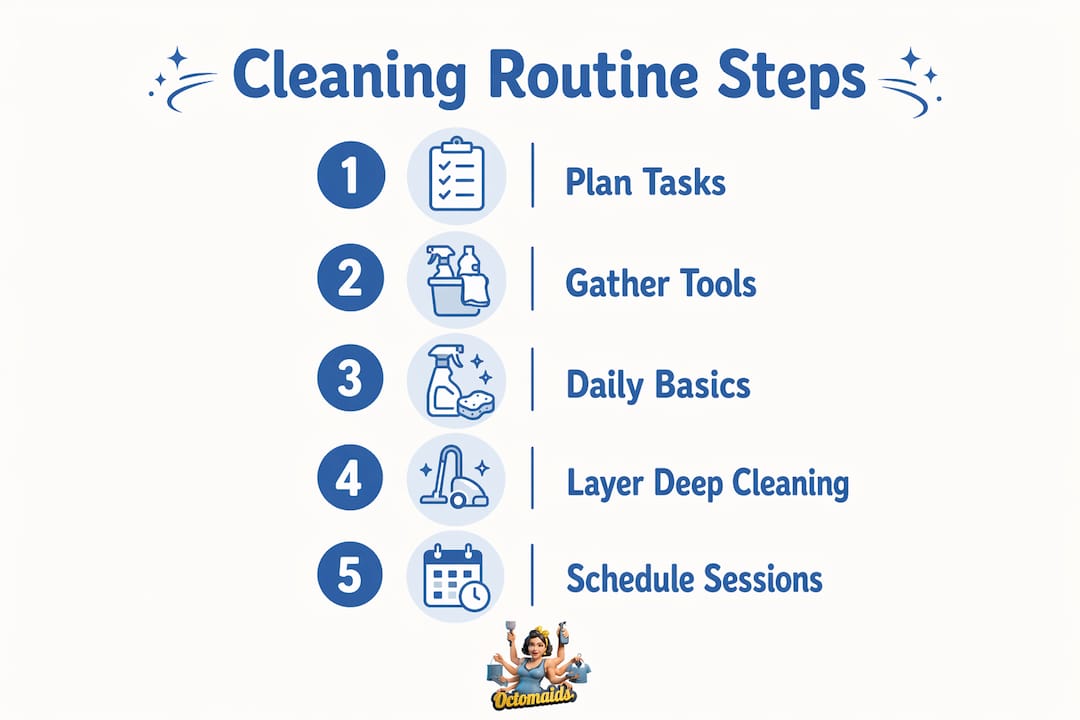
A weekly cleaning routine is a structured, repeatable system that divides household tasks across seven days so no single session takes more than 30 minutes. Most households maintain a tidy home spending roughly 3–5 hours per week, which breaks down to about 30 minutes per day when tasks are well-distributed. That number is achievable for busy individuals and families, but only when the system is built correctly from the start. This guide shows you exactly how to create weekly cleaning routine fast, using tools, scheduling methods, and habit strategies that professional cleaners rely on every day.
How to create a weekly cleaning routine fast
The fastest way to build an efficient cleaning schedule is to stop thinking about rooms and start thinking about tasks. Cleaning by task type, such as dusting all rooms first, then vacuuming all floors, eliminates the constant tool-switching and backtracking that makes cleaning feel endless. Efficient cleaning follows a top-to-bottom workflow and a task-based approach to reduce redundant movement. This single shift can cut your total cleaning time by a significant margin before you change anything else.
The second principle is layering. Start with only the daily basics, such as wiping counters and a quick floor sweep, and add one weekly focus task per day after you have stabilized that foundation. Layering cleaning by starting with daily basics and adding weekly tasks gradually reduces overwhelm and makes the routine stick. Think of it like building a habit muscle: you do not start with the heaviest weight on day one.

What tools do you need for a fast cleaning routine?
The right supplies cut cleaning time before you even start. Professional cleaners carry all essential supplies in a portable kit or apron, which eliminates wasted trips back to the supply cabinet. Carrying supplies in a portable kit is one of the most cited time-saving habits from maid service professionals, including Debbie Sardone, a well-known cleaning industry consultant. A simple cleaning caddy or apron loaded with small spray bottles and folded cloths keeps everything within arm’s reach.
Color-coded microfiber cloths prevent cross-contamination between surfaces and eliminate the need to re-clean areas you have already finished. For example, use blue cloths for glass and mirrors, yellow for kitchen surfaces, and red for bathrooms. This system removes guesswork and keeps your workflow moving in one direction.
Here is a breakdown of what you actually need versus what is optional:
| Supply | Type | Time-Saving Benefit |
|---|---|---|
| Color-coded microfiber cloths | Essential | Prevents cross-contamination and re-cleaning |
| All-purpose spray cleaner | Essential | Handles most surfaces with one product |
| Portable cleaning caddy or apron | Essential | Eliminates trips back to the supply cabinet |
| Vacuum with attachments | Essential | Handles floors and upholstery in one pass |
| Extendable duster | Essential | Reaches ceiling fans and high shelves quickly |
| Mop with reusable pad | Essential | Faster than traditional mop and bucket |
| Toilet brush and bowl cleaner | Essential | Dedicated tool prevents cross-use |
| Glass cleaner | Optional | All-purpose spray often handles this |
| Scrubbing brush set | Optional | Useful for grout and tile detail work |
| Steam cleaner | Optional | Speeds up deep cleaning sessions |
Pro Tip: Fill small spray bottles with your all-purpose cleaner instead of carrying full-size bottles. Lighter caddy means faster movement between rooms.
How to organize and schedule your weekly cleaning tasks
A structured weekly house cleaning guide works best when it assigns one focus area per day rather than trying to clean everything at once. A cleaning schedule can be tuned with 15, 30, or 60-minute daily sessions depending on your household size and weekly workload. The 30-minute model works well for most families with two to four people in a standard three-bedroom home.
Here is a sample weekly schedule built around 30-minute daily sessions:
- Monday: Bathrooms. Scrub toilets, wipe sinks and counters, clean mirrors, and mop floors. Time: 25–30 minutes.
- Tuesday: Kitchen. Wipe appliance exteriors, clean stovetop, sanitize counters, and sweep and mop the floor. Time: 25–30 minutes.
- Wednesday: Dusting. Dust all rooms top to bottom, including ceiling fans, shelves, and baseboards. Time: 20–25 minutes.
- Thursday: Vacuuming. Vacuum all carpeted rooms and rugs in one pass. Time: 20–25 minutes.
- Friday: Living areas. Wipe down surfaces, fluff cushions, and do a quick floor sweep. Time: 15–20 minutes.
- Saturday: Laundry and linens. Wash and change bed linens, run laundry loads. Time: 20 minutes active, rest is machine time.
- Sunday: Rest or catch-up. Use this day only if something was missed during the week.
The top-to-bottom, left-to-right workflow applies within each session. Starting and finishing in the same spot in each room eliminates wasted movement and keeps you from doubling back over areas you have already cleaned.
| Session Length | Best For | Weekly Total |
|---|---|---|
| 15 minutes | Single adults, small apartments | 1.75 hours |
| 30 minutes | Families, 2–4 person households | 3.5 hours |
| 60 minutes | Large homes, 5+ person households | 7 hours |
Pro Tip: Set a physical timer or use a phone app for each cleaning session. When the timer ends, you move on. This prevents the common trap of spending 20 minutes on one bathroom sink.
What are common mistakes in a fast weekly cleaning routine?
Common mistakes that slow cleaning down include over-focusing on small areas, switching tools too often, and letting the routine fall apart after a few weeks. Each of these mistakes adds time without adding cleanliness. Recognizing them early keeps your quick cleaning routine from becoming a slow one.
The most damaging mistake is inconsistency. Skipping two or three sessions in a row turns maintenance cleaning into catch-up cleaning, which can take two to three times longer. Consistency in cleaning high-traffic areas daily prevents the kind of buildup that requires long weekend deep cleans. A quick wipe of the kitchen counter every evening takes 90 seconds. Scrubbing baked-on grease takes 20 minutes.
Here are the most common traps to avoid:
- Overcleaning one spot. Spending 10 minutes scrubbing a single tile means the rest of the bathroom gets rushed or skipped. Set a timer and move on.
- Changing tools mid-room. Switching from a cloth to a brush to a different cloth breaks your momentum. Bring everything you need before you start.
- Cleaning without a path. Moving randomly around a room means you will walk over areas you just cleaned. Always work top to bottom, left to right.
- Skipping daily micro-tasks. Two minutes of wiping down the bathroom sink each morning prevents a 15-minute scrub session on Thursday.
- Building a routine that is too ambitious. A 90-minute daily cleaning plan will not survive a busy week. Start with 15 minutes and build up.
“The goal of a fast cleaning routine is not a perfect home. It is a consistently clean home that never requires a full-day recovery session.”
Pro Tip: Before starting any cleaning session, do a 60-second “supply check.” Make sure your caddy has everything you need. One missing spray bottle can cost you five minutes of backtracking.
For a room-by-room breakdown of what to cover during each session, the living room cleaning checklist from NYC Steamers is a practical reference to keep on hand.
How do you maintain a fast cleaning routine long-term?
Maintenance cleaning and catch-up deep cleaning are two different activities. Maintenance cleaning is the 30-minute daily session that keeps your home at a consistent baseline. Catch-up deep cleaning is what happens when maintenance breaks down. The goal of a sustainable routine is to stay in maintenance mode as much as possible. You can find a detailed home cleaning frequency guide from Octomaids that maps out exactly which tasks belong in each category.
When life gets hectic, use the 15-minute home reset instead of skipping entirely. A 15-minute home reset covers five zones: trash and dishes, laundry, surfaces, floors, and prep for the next day. This keeps the home from sliding into chaos during a busy week without requiring a full session. Think of it as a minimum effective dose for home cleanliness.
Here are four strategies for keeping the routine alive long-term:
- Habit stacking. Attach cleaning micro-tasks to existing habits. Wipe the bathroom sink after brushing your teeth. Sweep the kitchen floor after cooking dinner. The task gets done without requiring a separate decision.
- Weekly home reset. Every Sunday, spend 15 minutes walking through the five key zones. This is not a full clean. It is a reset that prepares the home for the week ahead.
- Flexible scheduling. If Thursday’s vacuuming gets skipped, move it to Friday. Do not abandon the week. One missed session does not break a routine; abandoning it does.
- Accountability. Share your cleaning schedule with a partner or housemate. Two people maintaining the same system cuts individual time in half and creates natural accountability.
When the routine genuinely cannot keep up, such as during a move, a new baby, or a major work deadline, professional cleaning services fill the gap without letting the home deteriorate. Maintaining a clean home between visits is far easier when a professional deep clean resets the baseline first.
Cleaning professionals stress consistency over intensity to avoid the time-consuming catch-up sessions that derail even the best-planned routines. That principle is the foundation of every sustainable cleaning habit.
Key takeaways
A fast, manageable weekly cleaning routine succeeds when it is built on task-based scheduling, the right portable tools, and daily consistency rather than occasional intense effort.
| Point | Details |
|---|---|
| Task-based scheduling | Clean by task type across all rooms before switching tasks to cut movement and tool changes. |
| Portable supply kit | Carry all supplies in a caddy or apron to eliminate wasted trips and keep momentum. |
| 30-minute daily sessions | Most households stay clean with roughly 30 minutes per day when tasks are well-distributed. |
| Consistency beats intensity | Daily micro-tasks prevent buildup that turns into hours of catch-up deep cleaning. |
| Flexible reset option | A 15-minute home reset covering five zones keeps the routine alive during busy weeks. |
What i have learned after years of watching families clean
The most common thing I see is people building a cleaning routine that works perfectly on paper and falls apart by week three. The schedule is too long, the supply list is too complicated, or the routine requires every family member to cooperate at exactly the right time. Real life does not work that way.
What actually works is a system with a very low floor. If your “good” day is 30 minutes and your “bad” day is still 10 minutes, you stay in the game. The families I have seen maintain genuinely clean homes are not the ones with the most elaborate checklists. They are the ones who do something every single day, even when it is small.
The right tools matter more than most people realize. I have watched people spend 45 minutes cleaning a bathroom that should take 15, simply because they were making three trips to the supply cabinet and using the wrong cloth on the wrong surface. A loaded caddy and color-coded microfiber cloths are not luxuries. They are the difference between a routine that holds and one that collapses.
My honest advice: start smaller than you think you need to. Build the 15-minute version first. Once it becomes automatic, add the 30-minute version. You will be surprised how quickly a modest daily habit produces a home that feels genuinely clean, not just temporarily tidied.
— Steven
How Octomaids can support your weekly cleaning routine
Even the best weekly routine has limits. Deep cleaning tasks like scrubbing grout, cleaning inside appliances, or washing baseboards require time that most busy households simply do not have. Octomaids has served homeowners across Vancouver, WA and Portland, OR since 2006, providing recurring cleaning, one-time deep cleans, and move-in/move-out services that reset your home to a professional baseline.
When your routine needs a reset or life gets too busy to keep up, Octomaids sends the same trusted cleaners every visit so you are never starting over with a stranger. Explore our home cleaning best practices or browse our full cleaning services to find the right fit for your household. A professional deep clean once a month or once a quarter makes your daily 30-minute routine dramatically easier to maintain.
FAQ
How long does a weekly cleaning routine take each day?
Most households maintain a tidy home spending about 30 minutes per day when tasks are distributed across the week. Smaller households or apartments can maintain cleanliness with 15-minute daily sessions.
What is the fastest way to organize cleaning tasks?
Cleaning by task type across all rooms, rather than cleaning one room completely before moving to the next, reduces tool changes and backtracking. Pair this with a top-to-bottom, left-to-right workflow in each room for maximum speed.
What should i do when i am too busy to follow my routine?
Use a 15-minute home reset covering five zones: trash and dishes, laundry, surfaces, floors, and next-day prep. This keeps the home from deteriorating without requiring a full cleaning session.
How do i stop my cleaning routine from falling apart after a few weeks?
Setting timers for each task and stacking cleaning micro-tasks onto existing daily habits are the two most effective strategies for long-term consistency. Skipping one session is fine; abandoning the schedule entirely is what breaks the routine.
When should i call a professional cleaning service?
Call a professional service when catch-up cleaning has built up beyond what your routine can handle, or when deep cleaning tasks like grout, appliances, or baseboards are overdue. Octomaids offers one-time and recurring services across Clark County, WA and the Portland Metro area to reset your home and make daily maintenance far easier.

