


A breakroom fridge cleaning policy works when it names a day, a person and a rule for unlabeled food, and when the deep clean is handed to a team whose scope is written down. Reminders and goodwill alone rarely hold. If you manage an office in the Vancouver, WA or Portland, OR area, we at Octomaids clean offices on recurring schedules, so the fridge can sit on the same written scope as your counters, sinks and restrooms.
This guide gives you the policy elements, a sample weekly and monthly routine, the cleaning method, and a short section on restroom odors, since managers usually own both problems.
Key Takeaways
- Put four things in writing: a weekly purge day and time, a labeling rule, a named owner, and a monthly deep clean.
- Specific rules beat vague ones. “Label with name and date” is enforceable; “be considerate” is not.
- Janitorial contracts often leave fridge interiors out unless the scope says otherwise, so write the fridge into the agreement.
- Persistent restroom odor is usually a drain, plumbing or ventilation signal, not something air freshener fixes.
Table of Contents
- What a Breakroom Fridge Policy Should Include
- Write Rules Specific Enough to Enforce
- Who Cleans the Fridge, and How Often
- How to Deep Clean an Office Fridge
- Put the Fridge in Your Cleaning Contract
- Roll the Policy Out So People Follow It
- Restroom Odor Control Belongs in the Same Plan
- Our Perspective
- Have Your Breakroom Cleaned on a Schedule
- FAQ
- Sources
What a Breakroom Fridge Policy Should Include
The policy can fit on one page. A fridge maintenance plan template names five elements: designated responsibility, clear food rules, scheduled cleaning intervals, supplies kept in the breakroom, and reminders. Those map to the sections below.
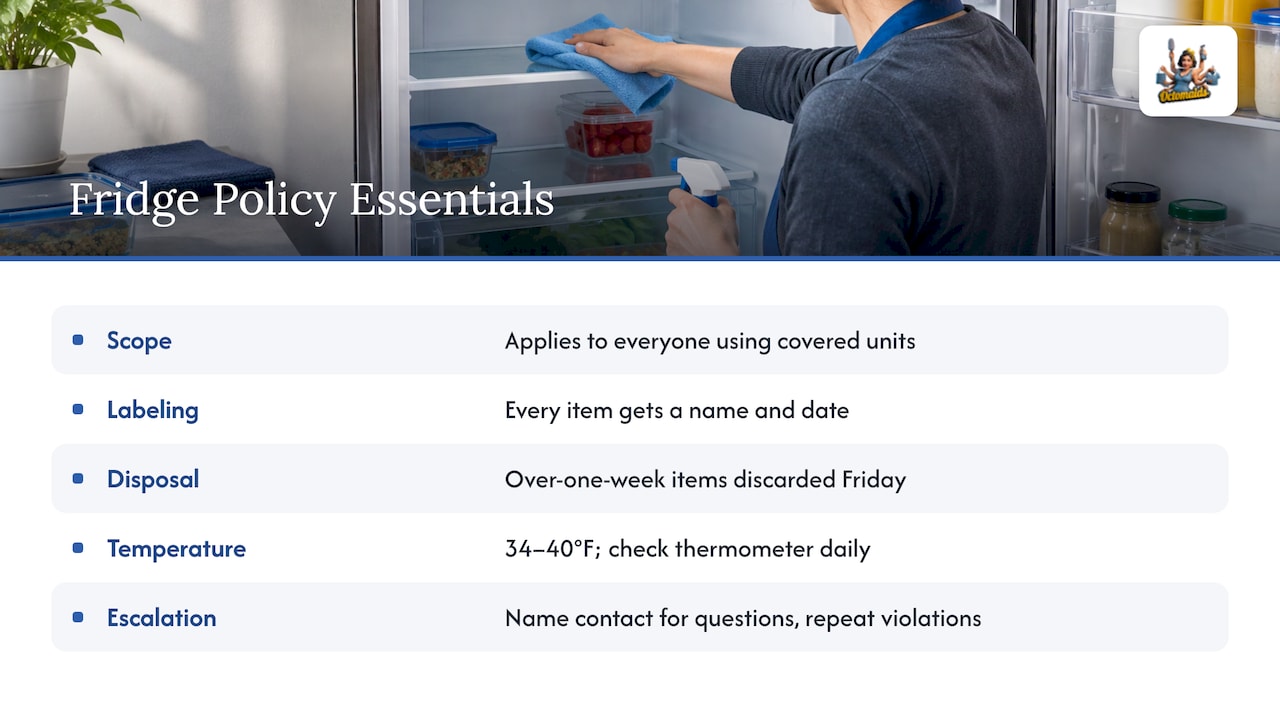
Scope. Say which fridges and freezers the policy covers, and that it applies to everyone who uses them.
Labeling. Every item carries a name and date. The U.S. Department of Veterans Affairs’ employee health guidebook recommends keeping marking pens or tape in the break room so labeling takes seconds.
Disposal. State a fixed schedule, for example items older than one week are discarded every Friday, and that unlabeled or expired items may be thrown out without notice, as LegalClarity’s workplace policy guide suggests.
Overcrowding. The same VA guidebook calls for no stacking of food containers in the fridge. A packed fridge hides spoiled food and blocks airflow.
Temperature. The VA guidebook directs that office refrigerators be kept at 34 to 40°F, with a thermometer at eye level and someone assigned to check it daily. A cheap appliance thermometer and a name on a checklist cover this.
Escalation. Name one person, such as the office manager or HR contact, who answers questions and handles repeat violations.
Write Rules Specific Enough to Enforce
LegalClarity observes that cleanliness rules are where policies earn their keep or collect dust, and that vague language gives no one a standard. Compare:
| Vague | Enforceable |
|---|---|
| Keep the fridge clean | Wipe up spills immediately; label food with name and date |
| Remove old food | Unlabeled items and anything from the previous week are discarded every Friday at 4:00 PM |
| Everyone pitch in | The cleanout rotates weekly by team, listed on the posted calendar |
| Report problems | Send questions to the office manager |
The Friday 4:00 PM purge comes from a US office fridge policy template, which also suggests posting a sign the day before each purge and a monthly email reminder. Pick a time that fits your own schedule; what matters is that it never moves.
Who Cleans the Fridge, and How Often
The VA guidebook recommends a rotating weekly schedule, a designated day and time for throwing out food, and a designated food safety monitor authorized to discard items that break the policy. It also recommends involving employees when the policy is drafted, and rotating the weekly cleanout, because shared ownership helps people follow the rules.
A workable cadence for most offices:
- Daily: wipe spills when they happen; check the thermometer.
- Weekly: purge unlabeled and old items, wipe shelves and door handles. Kimberly-Clark’s workplace hygiene guide also puts weekly fridge cleaning and food-dating reminders in the breakroom routine, alongside daily cleaning of countertops, sinks and appliances.
- Monthly: full deep clean, described next.
- Annually: vacuum the condenser coils, per the Blue Collar Clean template linked above.
Staff can manage the weekly purge. The monthly deep clean is where most offices fall behind, because it takes emptying the unit, washing removable parts and drying everything, and nobody’s job description includes it.
How to Deep Clean an Office Fridge
The VA guidebook gives a method you can copy into the policy:
- Move perishable food to a cooler, or place it on a counter briefly while you work.
- Mix 2 tablespoons of baking soda per quart of warm water.
- Wash from top to bottom: interior walls, shelves, exterior walls, door handles and the gasket (the rubber seal around the door).
- Rinse with warm water.
- Finish with a sanitizer.
The monthly template above adds removing shelves and door bins to wash them separately and cleaning the gaskets with mild detergent. Strasair’s schedule also suggests checking condiment expiration dates during the monthly or quarterly overhaul, and cleaning condenser coils. Master Odor Removal’s office odor guide includes the fridge drip tray in its weekly breakroom appliance cleaning, a spot people forget.
If you want the whole kitchen covered by the same standard, our office kitchen cleaning checklist lays out each task, and the office deep cleaning checklist places the breakroom among the other areas.
Put the Fridge in Your Cleaning Contract
This is the gap most policies miss. Osorio Services’ guide to office cleaning responsibilities states that refrigerator, microwave and cabinet interiors are typically a periodic add-on or excluded unless written, and recommends a written statement covering who removes contents, authorization, schedule and disposal policy. Shared counters, tables and restroom fixtures are normally part of standard scope.
So your policy and your cleaning agreement should agree on:
- who removes the contents (staff on Friday, or the crew);
- who authorizes throwing out other people’s food;
- how often the interior is cleaned;
- what happens to items left behind.
When the weekly purge belongs to staff and the monthly interior clean belongs to the crew, neither side assumes the other did it. For a wider view of what to settle before you sign, see shared workspace sanitation practices and seven questions to ask before hiring a commercial cleaner.
Roll the Policy Out So People Follow It
- Post the policy on the fridge door and in the breakroom.
- Include it in new-hire onboarding, as the Blue Collar Clean template suggests.
- Post the VA-style master cleaning calendar in a visible spot with the rotation names on it.
- Keep supplies in the breakroom so no one has an excuse.
- Announce the first purge a week ahead, then keep the same day every week.
The VA guidebook even mentions incentives such as contests for completing cleaning duties. A small recognition for the cleanest week costs little.
Restroom Odor Control Belongs in the Same Plan
Breakroom and restroom smells reach the same people, and the same facilities owner usually handles both.
Clean the source, don’t mask it. IFMA’s Facilities Management Journal recommends enzymatic cleaners that break down organic material, updated HVAC filters, and regular walk-throughs of restrooms, kitchens and waste areas. Daily restroom work, including restocking and touchpoint cleaning, is in our office restroom cleaning standards.
Check the drains. Roto-Rooter’s commercial plumbing guide lists dried-out drain traps in rarely used floor drains, cracked drain lines, blocked vent stacks and organic buildup as causes of persistent odors. Its first step is to pour water into the infrequently used drain. Master Odor Removal’s guide suggests monthly flushing of those drains, and a trap primer if the smell returns within days.
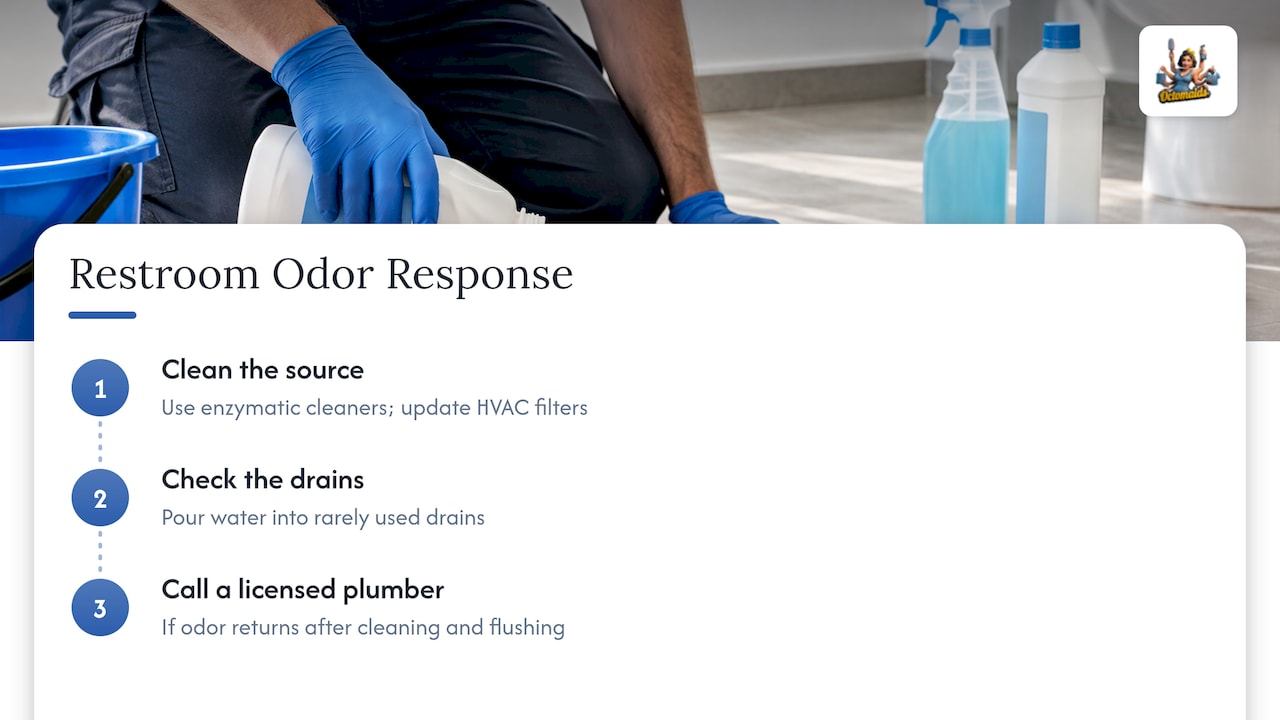
Know when to call a specialist. If the smell keeps returning after cleaning and flushing, call a licensed plumber or your building’s facilities contact. The EPA’s guidance for building owners says persistent odors are a sign the ventilation system may not be meeting occupants’ needs. Sewer gas can be a health concern at high enough concentrations, so a recurring smell deserves a real diagnosis.
Our Perspective
A fridge policy fails in a predictable way: everyone agrees with it and nobody owns it. We have seen the pattern across offices of every size, and the fix is the same each time. Write one page, name one person, and decide in advance who does the deep clean.
Our approach to commercial cleaning rests on consistency. We send the same dedicated, background-checked team to your building, so the people cleaning your breakroom know your layout, your fridge and your routine. Family-owned and locally operated since 2006, we would rather agree a clear written scope with you than leave the fridge as a gray area.
Treat the policy as the staff side and the cleaning scope as the crew side. Together they keep the breakroom something people are glad to use.
Steven
Have Your Breakroom Cleaned on a Schedule
Octomaids provides office cleaning and janitorial services for businesses in Clark County, WA and the Portland metro area, delivered by dedicated, background-checked, insured teams. Tell us what your policy expects, and we will build the breakroom into the scope. See our commercial and office cleaning services to get started.

FAQ
How often should an office fridge be cleaned?
Purge old and unlabeled food weekly, and deep clean monthly. The VA guidebook recommends a rotating weekly cleanout with a set day and time. Spills should be wiped up the same day.
Who is responsible for cleaning the office refrigerator?
Assign one named person or a rotating team for the weekly purge, and name one escalation contact. Decide in writing whether the monthly interior clean belongs to staff or your cleaning crew.
Can we throw out employees’ food?
Yes, if the policy says so in advance. State that unlabeled and expired items are discarded on the posted day without notice, and give everyone the rule at onboarding.
What temperature should the office fridge be?
The VA guidebook directs 34 to 40°F for refrigerators and 0 to -20°F for freezers, checked daily on a thermometer placed at eye level.
Does our janitorial service clean the fridge automatically?
Not necessarily. Fridge interiors are often a periodic add-on or excluded unless the contract says otherwise, so write the task, schedule and disposal rules into the scope.
Sources
- Food Sanitation Office Refrigerator, U.S. Department of Veterans Affairs
- Office Refrigerator and Microwave Cleaning Policy Template
- Office Cleaning Responsibilities: Staff vs. Janitorial
- Office Fridge Cleaning Schedule Template
- Food and Drink Policy in the Workplace
- A guide to creating a more hygienic workplace, Kimberly-Clark
- What Facility Visitors Smell Shapes What They Think, IFMA
- Common Office Plumbing Issues, Roto-Rooter
- Top Odor Sources in Offices, Master Odor Removal
- Guidance for Owners and Managers of Public and Commercial Buildings, EPA
Recommended
- Managers: Audit Ready Office Kitchen Checklist for Passing Inspections
- Shared Workspace Sanitation Best Practices Managers Can Use Today
- 7 Daily Tasks to Meet Office Restroom Cleaning Standards for Managers
About Octomaids
Octomaids is a locally operated professional cleaning company serving Vancouver, Clark County, and the surrounding Portland metro area. Since 2006, our cleaning teams have helped homeowners, renters, property managers, and businesses with recurring cleaning, deep cleaning, move-in/move-out cleaning, and commercial cleaning.
Our cleaning articles are reviewed to ensure the information reflects our real-world experience and professional cleaning practices.