


Airbnb expects every U.S. listing to be clean and free of health hazards before each check-in, with laundry, trash removal, vacuuming or sweeping, and surface wiping done between every stay. The hard part is doing that consistently, on a tight turnaround, for every guest. A same trained team that knows your listing is the most reliable way to hold the standard, and that is the service we provide to hosts in Vancouver, WA and the Portland metro area.
This guide explains what Airbnb actually requires, what a turnover clean should cover room by room, what guests are and are not asked to do, and what to do when a guest says the place was not clean.
Key Takeaways
- Airbnb requires a listing to be clean and hazard-free (no mold or pests, no heavy dust, pet dander or dirty dishes) before every check-in.
- A turnover clean is a repeatable routine: laundry, surfaces, bathrooms, kitchen, floors, trash and restocking, done in the same order every time.
- Starting November 20, 2026, Airbnb’s house-rules policy limits what hosts can ask guests to do at checkout. Cleaning stays the host’s job.
- If a guest reports a cleanliness problem, they have 72 hours to report it, so fast documentation and a fast fix protect your reviews.
- Consistency is the standard that wins five stars, and it comes from a checklist plus the same people doing it every time.
Table of Contents
- What Airbnb Requires of Hosts
- A Turnover Checklist That Meets the Standard
- Turnover Cleaning vs. Deep Cleaning
- What Guests Are Expected to Do
- When a Guest Reports a Cleanliness Problem
- Why Consistency Is the Real Standard
- Our Perspective
- Getting Your Listing Cleaned to Standard
- FAQ
- Sources
What Airbnb Requires of Hosts
Airbnb’s U.S. host standard is short and firm. Every listing must be clean and free of health hazards before check-in, and the page names mold and pests specifically. It also asks for a high standard of cleanliness, free of extensive dust, pet dander and dirty dishes. Cleaning is expected between every stay, not only when something looks off.
Notice what this is not. Airbnb does not publish a numbered, inspected certification that you pass once. The standard is the guest’s experience on arrival, and it is enforced through reviews, complaints and refunds. That is why “standard” in practice means a documented routine you can repeat and prove.
The five-step process from Airbnb’s cleaning protocol
In 2020 Airbnb published an enhanced cleaning protocol, and its U.S. quick-start guide still gives a useful structure. It divides the work into prepare, clean, sanitize, check and reset:
- Prepare. Ventilate the space and gather your equipment and an approved disinfectant.
- Clean. Remove dirt first, since disinfectant works on clean surfaces. Wash linens at the highest recommended heat setting, empty trash and replace liners, wash dishes, and clean hard surfaces with soap and water. Follow the manufacturer’s directions on soft surfaces.
- Sanitize. Keep the disinfectant wet on the surface for the label’s contact time, and do not re-enter the room while it works.
- Check. Go back over frequently touched surfaces such as remotes, doorknobs and light switches.
- Reset. Restock supplies and put the space back to how the listing presents it.
In June 2021 Airbnb said hosts and their teams had to implement the five-step process, and it relaxed two details: curtains no longer had to be washed between stays, and unused dishes in cupboards did not need washing. The structure remains a sound way to organize any turnover.
Using cleaning products safely
Airbnb advises hosts to use disinfectants approved by relevant government agencies, to follow the product’s wet-contact time, to never mix cleaners, and to keep chemicals away from children. Those four rules matter more than any brand choice. Mixing products is the one that causes real harm, so keep each one in its original labeled container. Our Airbnb cleaning supplies list covers what to stock for every turnover.
A Turnover Checklist That Meets the Standard
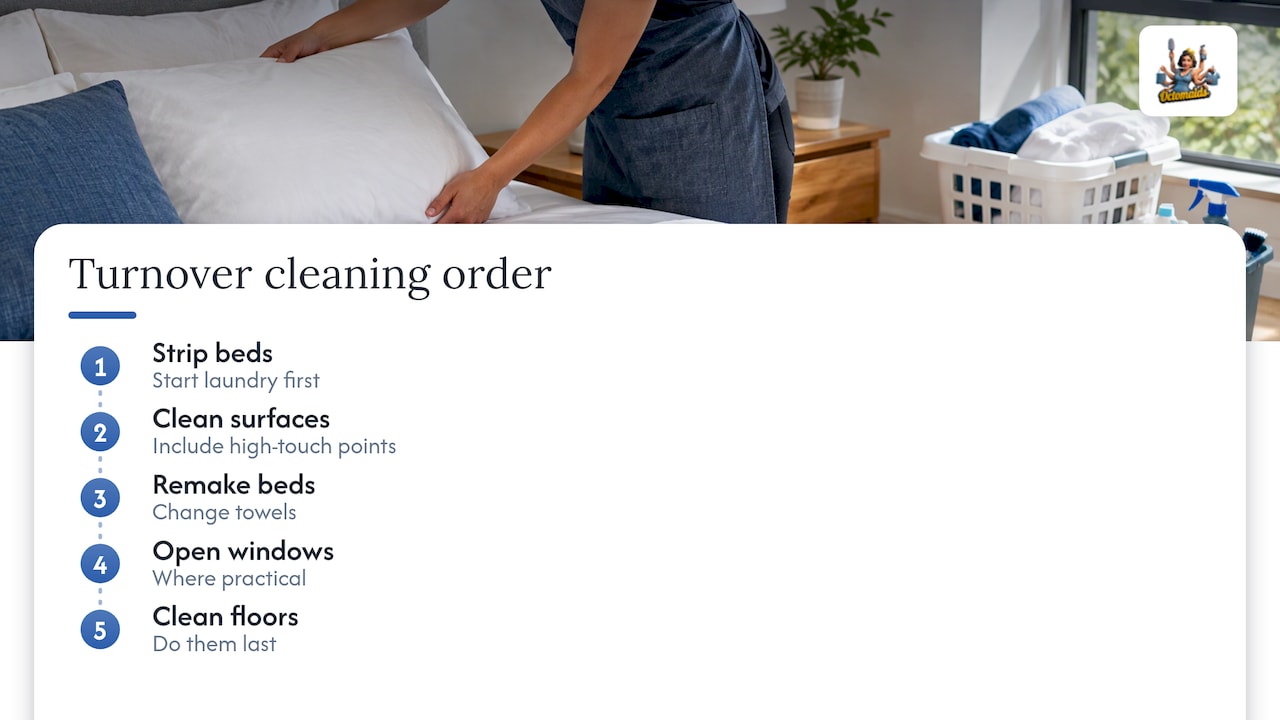
Airbnb’s own host guidance describes a clean listing as one with dusted surfaces, vacuumed or swept and mopped floors, stain-free linens and towels, remade beds, disinfected bathrooms, put-away dishes, clean appliances with no leftover food, removed trash and a fresh-smelling space. The same page suggests an order of work: strip beds and start laundry first, clean surfaces and high-touch points next, remake beds and change towels, open windows where practical, and do floors last. Working top to bottom and ending on the floors means you never re-clean something you just finished.
Airbnb also advises hosts to create a turnover checklist and follow the same routine before every check-in, with extra attention to high-traffic spots such as countertops, drains, soap refills and stray hair.
Bedrooms and living areas
- Strip and remake every bed with clean linens. Check sheets and pillowcases for stains and hair before the bed is made, not after.
- Replace towels and bath mats.
- Dust surfaces and décor, including under and behind furniture where guests can see.
- Wipe remotes, light switches, doorknobs and handles.
- Vacuum or sweep, including under furniture.
- Put away any personal items you stored for guests.
Bathrooms
- Clean and disinfect the toilet (seat, lid, base), sink, faucet, shower or tub and drain.
- Clean mirrors without streaks.
- Do a final hair check on the floor, in the tub and around the drain. It is the detail guests mention most in a bad review.
- Restock soap, toilet paper and towels.
- Empty the trash, replace the liner, and mop last.
Kitchen
- Remove all guest food and wipe the counters and appliance exteriors.
- Clean the microwave and stovetop and glance inside the oven.
- Check the refrigerator for leftovers and wipe the shelves.
- Run, empty and put away the dishes, and check them as they come out of the machine.
- Replace kitchen towels, restock consumables, take out the trash and mop.
Our short-term rental cleaning checklist goes deeper on each room, and the restocking checklist for hosts helps you avoid emergency supply runs between guests.
What five-star hosts add
In an Airbnb Resource Center feature, a professional cleaner who handles a dozen listings says going beyond the basics is what earns five stars. She keeps spare linen sets for same-day turnarounds and checks laundry and dishes as they come out of the machines. She also favors neutral scents, using open windows, an air purifier and diluted disinfectant on fabrics, rather than masking odors with bleach or air fresheners. Guests notice a space that smells of nothing far more favorably than one that smells of product.
Turnover Cleaning vs. Deep Cleaning
A turnover clean is the fast reset between guests. A deep clean is the periodic job that reaches what turnovers skip: inside the oven and refrigerator, grout, baseboards, windows, upholstery, vents and behind furniture. A property that only ever gets fast turnovers slowly degrades, and guests see it in corners before you do.
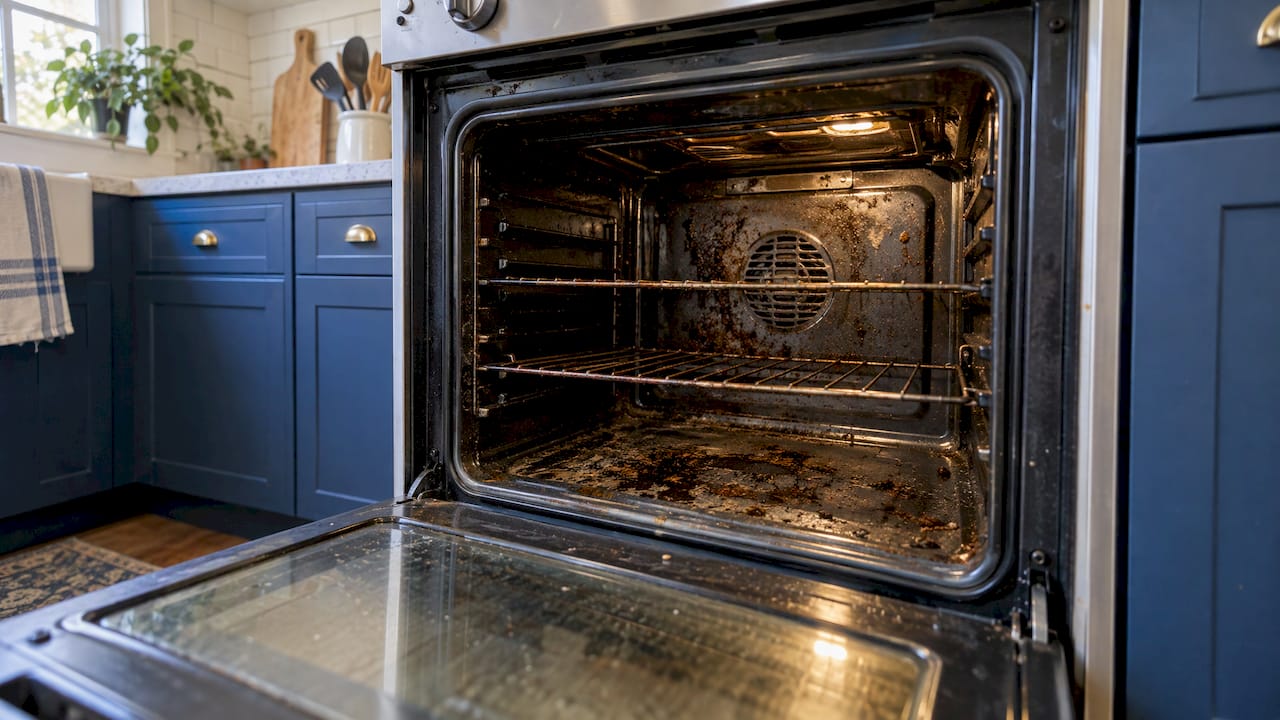
The same Airbnb feature recommends a deep clean every two or three months for jobs that do not fit between back-to-back stays, with a routine that covers under beds, inside drawers, cabinet doors, appliances and outdoor areas. A busy listing, one that takes pets, or one in a damp climate such as the Pacific Northwest tends to need them more often. If you want to see how the two differ in a home setting, read our deep clean vs. regular clean guide and our guide on why rental properties need deep cleans.
What Guests Are Expected to Do
Hosts often ask what they can reasonably expect from guests. Airbnb’s ground rules say guests should follow the host’s house rules, put trash in designated receptacles, be mindful of excessive trash, and not leave the listing in a state that needs excessive or deep cleaning, such as moldy dishes, soiled carpets or pet stains.
Two points follow from that page:
- The cleaning fee is meant to cover standard turnover work such as laundry and vacuuming. Hosts may not charge a guest a fee merely for skipping a listed checkout task, although cleanliness can affect the review.
- Real violations, such as filth that needs deep cleaning, go through documentation and the Resolution Center, not an invented penalty.
The house-rules change taking effect November 20, 2026
Airbnb’s updated house-rules policy takes effect on November 20, 2026. Under it, additional checkout requests must be reasonable. Hosts may ask guests to put dishes in the sink, gather used towels, sort trash and recycling into designated indoor bins and turn off utilities. They generally may not require washing and putting away dishes, stripping beds, starting laundry, taking garbage off-site or other significant cleaner-type work. Exceptions can reflect local conditions, such as wildlife-resistant trash disposal in bear country or limits on showers during drought restrictions.
Airbnb’s own host guidance adds that a checkout should be relatively simple, since tasks a cleaner should handle can harm stays and reviews. The practical conclusion for a host: plan your turnover as though the guest did none of it. A long checkout list does not lower your cleaning standard. It lowers your rating.
When a Guest Reports a Cleanliness Problem
Airbnb’s guest help page says guests have 72 hours from noticing a cleanliness issue to report it. They are asked to document it with photos or video and to contact the host first. They may negotiate a partial refund, for example the cleaning fee for a minor issue. If the host cannot resolve it, the guest can escalate to Airbnb for a full or partial refund or rebooking.
That sequence tells you what to prepare:
- Take time-stamped photos after every turnover. Dated pictures of the clean bathrooms, kitchen and beds are your evidence if a dispute reaches Airbnb.
- Reply quickly. The host is usually the first point of contact, and a fast fix often ends the matter.
- Match the fix to the problem. A missed spot calls for a quick return visit. Anything involving mold or pests is a health issue and needs an immediate full clean.
- Add the miss to your checklist so it does not happen at the next turnover.
If Airbnb alleges that a guest broke a ground rule, the host can communicate with the guest, document the issue and request payment for damages through the Resolution Center, then leave an honest review.
Why Consistency Is the Real Standard
Airbnb’s rules describe a result. Reaching it every time depends on who does the work. A new cleaner each week means a new person guessing at what “clean” means in your listing: which towels fold which way, where the spare linens live, how you want the beds dressed. Mistakes show up as hair in a shower or a missed oven, and they land in a review.
That is why we send the same dedicated team to a property every visit. Our cleaners are background-checked, professionally trained and insured, and our services are satisfaction guaranteed. For a host, that means a team that learns your listing, follows your checklist, and notices when something has changed. If you are weighing a cleaning team against self-turnover, our piece on why short-term rental cleaning differs from residential cleaning explains where the work diverges, and our same-day Airbnb cleaning page covers tight turnaround windows.
Our Perspective
Since 2006 we have cleaned homes and rentals across Clark County and the Portland metro area, and the lesson from short-term rentals is simple: standards are easy to write down and hard to keep.
Airbnb’s checklist is sensible. Nobody disagrees that bathrooms should be disinfected and beds should be fresh. What separates a five-star listing from a three-star one is whether the same care happens on the busy Sunday as on the quiet Tuesday.
Our approach is to send the same team every time, so the person cleaning your listing today has cleaned it before and knows what the standard looks like there. We are family-owned and locally run, not a franchise, and the people who clean your property are background-checked, trained and insured.
If you host, think of cleaning as part of the product your guests buy. Treat it that way, and the reviews tend to follow.
Steven
Getting Your Listing Cleaned to Standard
If you host in Vancouver, WA or the Portland area and want turnovers handled by one dedicated team, we offer Airbnb and vacation rental cleaning, along with one-time deep cleaning for the periodic reset your property needs. Our team works from your checklist so each stay starts from the same clean baseline.

Look at our Airbnb and vacation rental cleaning service to see how it works, or get in touch through our services page to talk through your listing.
FAQ
Does Airbnb have an official cleaning checklist hosts must follow?
Airbnb publishes guidance and a recommended process rather than a mandatory form. Its host standard requires a clean, hazard-free listing before every check-in, with laundry, trash, floors and surfaces done between stays. Its five-step process (prepare, clean, sanitize, check, reset) is a good base for your own written checklist.
Do guests have to clean before they leave?
Guests should follow your house rules, put trash in the right place and avoid leaving the listing in a state that needs excessive or deep cleaning. From November 20, 2026, requests such as stripping beds or starting laundry are generally not allowed. Plan to handle the full turnover yourself or with a cleaning team.
How long do guests have to report a cleanliness problem?
Guests have 72 hours from noticing the issue to report it to Airbnb, and they are asked to contact the host first with photos or video. That window is why you should keep your own time-stamped photos from each turnover.
How often should an Airbnb get a deep clean?
Airbnb’s featured guidance suggests every two or three months for hidden buildup that turnovers skip. Listings with heavy bookings, pets or humid conditions may need them more often. Your own turnover inspections will show when corners, grout or appliances are slipping.
Sources
- Airbnb Help Center: host cleanliness standards
- Airbnb Help Center: ground rules for guests
- Airbnb Help Center: guest cleanliness issues
- Airbnb enhanced cleaning protocol, U.S. quick-start guide
- Airbnb: update to COVID-19 safety practices
- Airbnb Resource Center: cleaning supplies
- Airbnb Resource Center: ensuring your place is sparkling clean
- Airbnb Resource Center: prepare your space
- Airbnb Resource Center: clean like a pro
- Airbnb Resource Center: a clear and simple checkout
- Airbnb Resource Center: important changes to house rules
Recommended
- Airbnb Cleaning Supplies List: What to Stock for Every Turnover
- Why STR Cleaning Differs from Residential: 2026 Guide
- How Cleaning Shapes Your Rental Reviews and Ratings
- Why Rental Properties Need Deep Cleans: 2026 Guide
About Octomaids
Octomaids is a locally operated professional cleaning company serving Vancouver, Clark County, and the surrounding Portland metro area. Since 2006, our cleaning teams have helped homeowners, renters, property managers, and businesses with recurring cleaning, deep cleaning, move-in/move-out cleaning, and commercial cleaning.
Our cleaning articles are reviewed to ensure the information reflects our real-world experience and professional cleaning practices.